
Creatine Gummies vs Powder: Cost, Convenience, and What Actually Matters

Last updated: November 24, 2026
Quick Answer
In the creatine gummies vs powder decision, powder has the clearer research history and is often easier to compare on ingredient simplicity and total creatine in the container. Gummies can be convenient, but serving size, number of pieces and other ingredients vary substantially by product. The right choice depends on your budget, your tolerance for mixing a drink, and whether consistency matters more to you than convenience.
Key Takeaways
- Creatine gummies vs powder is a format decision, not a different supplement, both may list creatine monohydrate, the ingredient form with the deepest research history.
- Powder and gummies can list very different amounts per stated serving; compare the Supplement Facts panel and the number of pieces that make up a serving.
- Gummies can cost more per gram of listed creatine, while powder is often simpler to compare by total grams in the container.
- The label, stated serving size and manufacturing quality should be checked rather than assumed from the format alone.
- Gummies can offer practical advantages in taste, portability, and ease of use without mixing or a shaker bottle.
- Direct gummy-versus-powder performance research is limited; the established creatine evidence base is predominantly creatine monohydrate commonly supplied as powder.
- Consistency in daily use matters more than format for most practical outcomes.
Table of Contents
- The short answer: format matters less than the basics
- What creatine research actually studied
- Gummies vs powder at a glance
- Creatine powder: practical strengths and trade-offs
- Creatine gummies: practical strengths and trade-offs
- How to compare labels without getting fooled
- Does timing, mixing, or format change the core evidence?
- How to read the label and compare ongoing cost
- Who should be cautious or seek individual medical guidance?
- What to choose based on real-world routine, not marketing
- FAQ
The short answer: format matters less than the basics
Let’s keep this practical. The creatine gummies vs powder question isn’t really about which one “works”, both can deliver creatine monohydrate into your system. The real question is whether you consistently get enough of it, day after day, without overpaying or overcomplicating your routine.
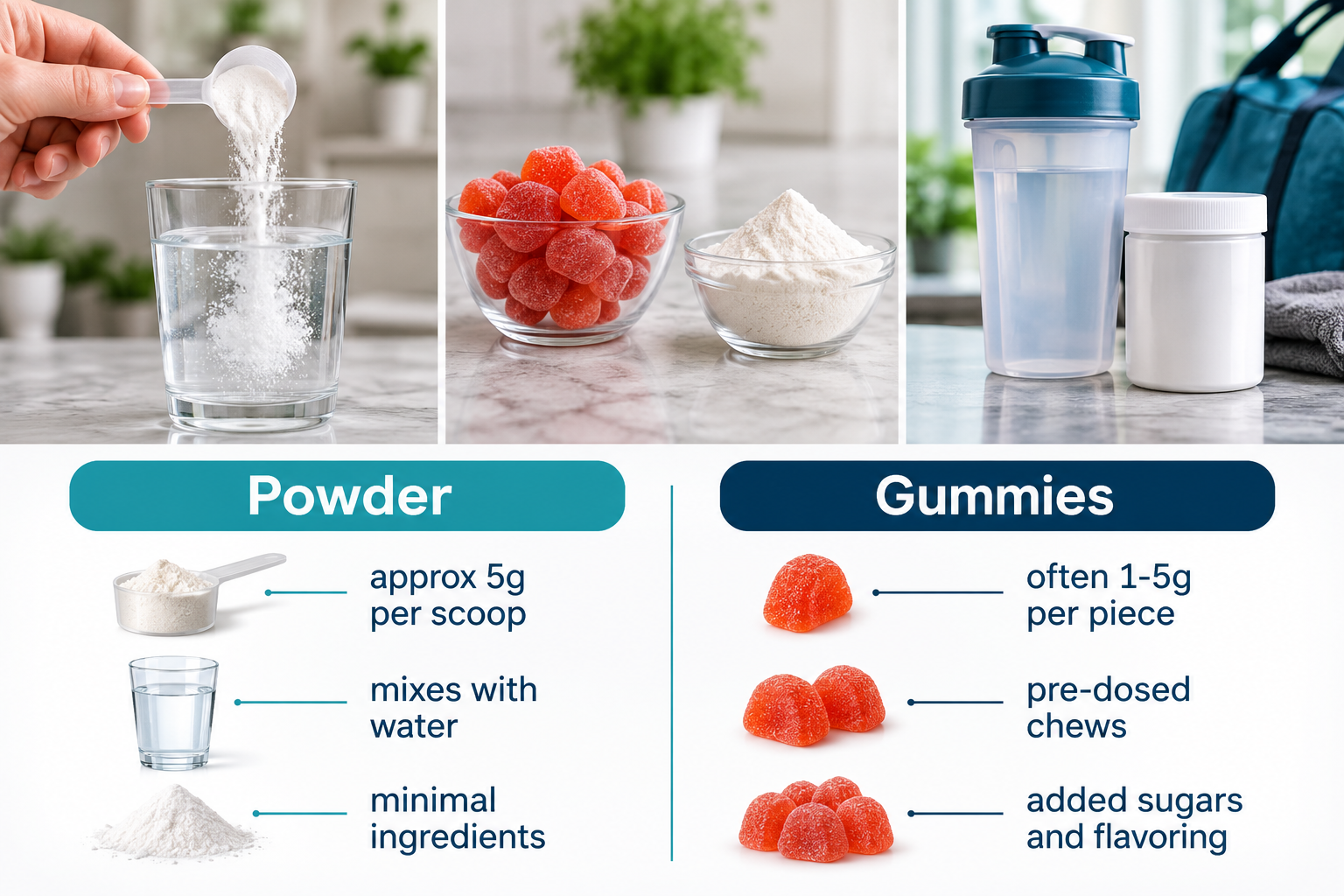
Here’s the real issue: creatine’s benefits, as far as the evidence shows, come from steady daily intake over weeks and months, not from a single dose or a particular delivery vehicle. The basics still do the heavy lifting. If a gummy format gets you to take creatine every day because you hate mixing powder, that adherence advantage is real and worth something. If a powder is cheaper and easier to dose accurately, that matters too.
The main takeaway is this: pick the format you’ll actually use consistently, then check that it delivers a reasonable daily amount without hidden costs or confusing serving sizes.
What creatine research actually studied
The stronger evidence points to creatine monohydrate, and most of that research used powder, not gummies. This is a point worth being honest about. We need to separate fact from hype here: a product containing creatine is not automatically validated by decades of monohydrate research just because the molecule is the same.
A few things to understand:
- Most foundational studies on strength, power output, and muscle creatine saturation used powdered monohydrate dissolved in liquid.
- Gummies are a newer delivery format, and manufacturers have not published head-to-head performance trials proving gummies produce identical outcomes to powder.
- That doesn’t mean gummies are ineffective, creatine is creatine once absorbed, but it does mean claims of “equal results” are an assumption, not a demonstrated fact.
That is a strong claim and needs strong proof: “gummies work exactly like powder for performance” is a claim some marketing suggests, but based on current evidence, it hasn’t been directly tested that way. What has been tested is creatine itself, largely in powder form, with study protocols varying by population and design.
Any discussion of creatine and brain or cognitive function remains genuinely mixed and still emerging in the research; it is not a reason to pick one format over another, and it shouldn’t be treated as settled science either way.
Gummies vs powder at a glance (format, label amount, ingredients, portability, mixing, cost per gram)
In plain English: powder tends to win on cost and dosing simplicity, gummies tend to win on convenience and taste. Here is a practical side-by-side look at the factors that actually affect daily use.
Choose powder if accurate dosing and cost matter most to you. Choose gummies if you know you won’t stick with a mixed drink but will reliably eat a few chewable pieces.
Creatine powder: practical strengths and trade-offs
From a practical point of view, powder is often the simpler format to compare because it can have a short ingredient list and a clear total amount in the container.
Strengths:
- Often a clearer total-gram and cost comparison
- Minimal additive burden, frequently just creatine monohydrate
- Easy to verify dose: one scoop, one measurement
- Can be mixed with water, juice, or a protein shake; creatine itself doesn’t require anything special to dissolve, though it may settle at the bottom of a glass if left standing
Trade-offs:
- Requires a shaker, spoon, or glass and a few seconds of mixing
- Slightly gritty texture that some people dislike
- Easy to forget if you’re away from home without your container
- Unflavored versions can be unappealing to some users daily
I prefer to look at what actually works over what’s marketed cleverly, and for cost-conscious, consistency-focused users, powder is hard to beat on paper. The catch is adherence: a perfect product you forget to use delivers zero benefit.
Creatine gummies: practical strengths and trade-offs
Let’s call it what it is: gummies are a convenience product first and a creatine delivery method second. That’s not a criticism, convenience drives consistency for a lot of people, but it explains the price difference.
Strengths:
- No mixing, no water, no shaker bottle
- Easier to travel with or keep at a desk, in a bag, or in a car
- Often more flavored than plain powder, which some people may find easier to use
- Pre-portioned pieces remove some guesswork, assuming the label is accurate
Trade-offs:
- Can be more expensive per listed gram of creatine
- May require multiple pieces to reach the label’s stated serving, which changes both convenience and cost
- Added sweeteners and other excipients can make the ingredient list longer than plain powder
- Quality and label transparency can vary between brands and should be assessed product by product
- Third-party quality testing may be a useful additional signal, but it is not a substitute for reading the label
In real-world terms, if you already dislike mixing powder enough that you skip your creatine three days a week, gummies solve a real adherence problem even at a higher price. If cost matters more than convenience, that math may not favor gummies.
How to compare labels without getting fooled
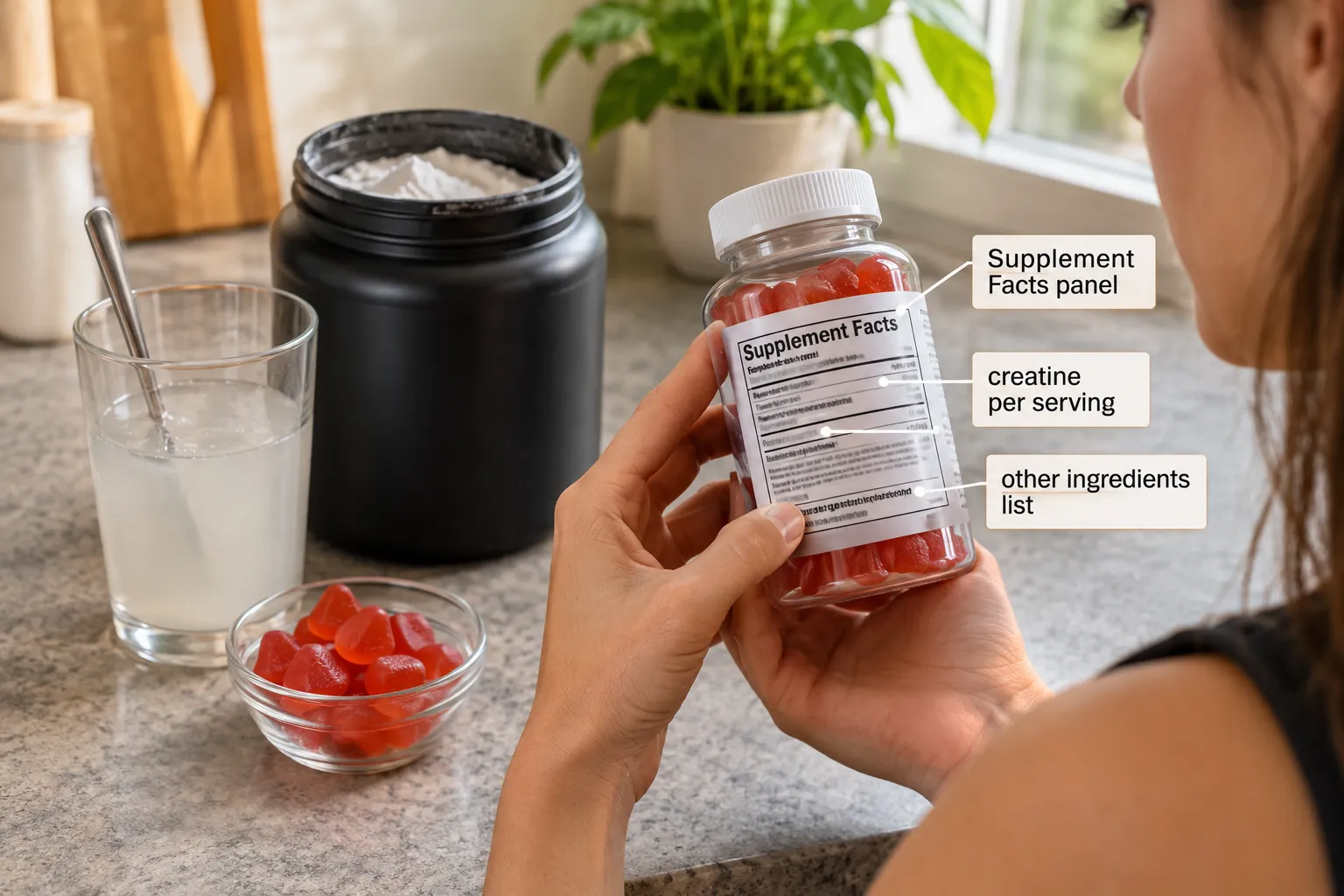
A sensible starting point is reading the Supplement Facts panel, not the front-of-package marketing. In plain English: look at the actual creatine amount per serving, how many servings make up a full daily dose, and what else is in the product.
Checklist for comparing labels:
- Find the exact creatine amount per serving (not per container).
- Check how many gummies or scoops equal that serving, a gummy serving can involve multiple pieces rather than one.
- Calculate the total creatine you’d get per day at the labeled serving size.
- Scan the ingredient list for added sugars, artificial colors, or fillers, especially in gummies.
- Look for third-party testing seals, where available, while recognizing that a logo does not replace a clear label.
- Divide total product cost by total grams of creatine delivered to get a real per-gram cost comparison.
I would be careful with that: a “high-potency” or “fast-acting” claim on a label is not the same as a verified dose. The numbers matter more than the adjectives on the front of the package.
Does timing, mixing, or format change the core evidence?
The simplest way to look at it is this: timing and format are secondary to total daily intake and consistency. There is no magic in it. No strong direct evidence establishes a gummy-format advantage over powder on the outcomes readers usually care about.

Context matters, though:
- Creatine powder can be mixed with water, juice, milk, or a shake; it doesn’t require anything special to “work,” though some people find it dissolves better in warmer liquid.
- Gummies don’t require mixing at all, which removes one adherence barrier but doesn’t change absorption in any way that’s been specifically demonstrated to be superior.
- Whether you take creatine before or after exercise has been debated, but this comparison is not about timing protocols, it depends on individual routine and preference, and it isn’t a format-specific question.
This is where hype gets in the way: phrases like “faster absorption” or “enhanced bioavailability” on gummy packaging are marketing language, not something established by independent, published performance trials specific to gummies. Based on current evidence, the core effect of creatine depends on consistent intake of an adequate amount, not the vehicle carrying it.
Who should be cautious or seek individual medical guidance?
What matters most is this: creatine, in any format, is a supplement that interacts with individual health circumstances, and some people should talk with a clinician before starting either gummies or powder. This section applies regardless of which format you’re considering.
Consider professional guidance if you:
- Are pregnant or breastfeeding
- Have kidney disease or any condition affecting kidney function
- Are under clinical care for a chronic condition
- Take prescription medications, or have questions about supplement use alongside prescribed treatment
- Have a history of gastrointestinal sensitivity, because the ingredient list and tolerance can matter for some people
- Are considering creatine for a minor or an older adult with existing health conditions
Gastrointestinal tolerance varies from person to person. Some people notice bloating with higher single doses, regardless of whether that dose comes from powder or multiple gummies. Starting with a smaller amount and watching how your body responds is a reasonable, cautious approach, though this is a general observation, not a specific dosing instruction. If you want foundational background on what creatine is and how it functions in the body, see our guide: What Is Creatine and What Does It Do?.
What to choose based on real-world routine, not marketing
Start with what gives the biggest return: consistent daily intake of a reasonable creatine amount, at a price you’re comfortable paying long-term. Clear beats clever here.
A practical decision framework:
- Choose powder if you want the lowest cost per gram, don’t mind mixing a drink, and want the simplest possible ingredient list.
- Choose gummies if you travel often, dislike mixing powder, or have consistently skipped a liquid-based supplement in the past and know a chewable format will stick.
- Choose neither, for now, and talk to a clinician first, if you fall into any of the caution categories above.
- Be skeptical of products promising dramatically faster or stronger effects purely because of format, more is not always better, and a flashier gummy formula isn’t automatically a better one.
Keep it simple and consistent. The format you’ll actually use every day, at a price you won’t resent, is usually the right one. Evidence first, hype second.
How to read the label and compare ongoing cost
“One tub” and “one bag” are not useful units for comparing two different formats. The number that matters is the amount of creatine the label says is in the whole container, alongside the price and the number of servings it actually contains. A gummy jar can look generous because it contains many pieces, while a powder bag can look less substantial despite listing a larger total amount of the active ingredient. Neither package style tells the whole story.
A sensible comparison starts with the Supplement Facts panel, not the front-label promise. First identify the stated form of creatine. Then note the amount listed for one serving and how that serving is defined. With gummies, a serving may be several pieces; with powder, it may be a scoop. Finally, look at the total number of servings and the other ingredients that come with the format. That sequence helps separate a genuinely convenient product from a package that simply makes comparison difficult.
Cost is also more useful when treated as an ongoing decision rather than a single checkout price. People comparing formats can write down the container price, total listed creatine, servings, and any extra ingredients that matter to them. This does not require a perfect formula or a promised outcome. It simply makes the trade-off visible: some readers may decide that convenience is worth paying for; others may prefer a simpler powder and fewer extras.
There is also a practical distinction between precision and certainty. A clear label and a simple serving format make it easier to understand what the manufacturer says the product contains. They do not turn a supplement into a guarantee, and they do not mean every person will have the same response. That is why this comparison should stay grounded in label clarity, budget, preference, and the much larger evidence base behind creatine monohydrate itself.
What this comparison can—and cannot—tell you
This page can help readers distinguish a practical format choice from a performance claim. It can show why powder is closer to the form used in most research, why gummies may be easier for some people to take consistently, and how ingredient lists change the everyday trade-off. It cannot tell a reader that a particular gummy will produce the same outcome as a particular powder, because direct head-to-head research on those commercial delivery formats is limited.
It also cannot answer every question that sits beside the topic. Creatine is sometimes discussed in relation to strength training, healthy aging, recovery, or cognition, but those are separate evidence questions with their own populations and limits. A better format is not proof of a better outcome. The useful starting point is still to understand the ingredient, the product label, and personal context before treating a delivery format as the deciding factor.
For broader background on the compound and the evidence around it, visit What Is Creatine and What Does It Do?. That pillar explains the bigger picture; this article stays focused on the choice between gummies and powder.
FAQ
What’s the difference between creatine gummies and powder?
The core ingredient is usually sometimes the same declared creatine ingredient, but gummies usually also add sweeteners, a gelling agent and flavoring; serving size may involve more than one piece.
Does creatine gummies work as well as powder?
Direct gummy-versus-powder performance trials are limited, while the established research base is largely creatine monohydrate commonly provided as powder.
Are creatine gummies more expensive than powder?
They can be. Compare each product using total listed creatine in the whole container, price, and the number of pieces in a serving rather than relying on package size alone.
How long does it take for creatine gummies to work?
There’s no evidence that gummies act faster or slower than powder. Creatine’s effects build gradually with consistent daily intake over weeks, not from a single dose in either format.
Can you mix creatine powder with anything?
Powder can typically be mixed with water, juice, milk, or a protein shake without affecting its basic function; it doesn’t require a specific liquid to be effective.
What are the side effects of creatine gummies?
Some people report gastrointestinal discomfort with supplements, and gummy ingredients may matter for people sensitive to particular sweeteners or gelling agents.
Do creatine gummies cause bloating?
Some people report bloating with creatine regardless of format, and added sweeteners in gummies may contribute for sensitive individuals; tolerance varies by person.
Is creatine powder or gummies better for muscle growth?
Based on current evidence, powder has the stronger direct research history because it is the format commonly used in the established creatine-monohydrate studies.
Who shouldn’t take creatine gummies?
The same caution applies as with powder: people who are pregnant or breastfeeding, have kidney disease, are under clinical care, or take relevant medications should consult a clinician first.
Do you need to load creatine gummies?
This article doesn’t prescribe a loading protocol for either format; loading approaches should be discussed with a qualified professional based on individual goals and health status.
What’s the best way to take creatine?
There’s no single required method; what matters most is consistent daily intake of an appropriate amount, in whichever format you’ll actually stick with.
Are there other forms of creatine besides powder and gummies?
Yes, creatine is also sold as capsules, chewable tablets, and liquid formulations, while creatine monohydrate powder remains the format most often represented in the established research.
References
- Antonio J, Candow DG, Forbes SC, et al. Common questions and misconceptions about creatine supplementation: what does the scientific evidence really show? Journal of the International Society of Sports Nutrition. 2021.
- Kreider RB, Kalman DS, Antonio J, et al. International Society of Sports Nutrition position stand: safety and efficacy of creatine supplementation in exercise, sport, and medicine. JISSN. 2017.
- Effect of creatine supplementation on kidney function: a systematic review and meta-analysis. 2025.
- The effects of creatine supplementation combined with resistance training on skeletal muscle hypertrophy: a systematic review and meta-analysis. 2023.
Medical disclaimer
This article is for informational purposes only and is not medical advice. Always consult a qualified healthcare provider before making changes to your diet, exercise, supplements, or medications.

About the author
Dave James is the founder of All Perfect Health. He writes practical, evidence-aware health guides for readers who want clear thinking without hype. He is not a doctor.
📂 Creatine
A focused APH cluster on creatine evidence, practical choices and safety context.
Pillar: What Is Creatine and What Does It Do?
YOU ARE HERECreatine Gummies vs Powder: Cost, Convenience, and What Actually Matters