
What Is Creatine and What Does It Do?

Last updated: November 24, 2026
Quick Answer
Creatine is a small, naturally occurring compound your body makes and stores mostly in muscle, where it helps regenerate ATP, the molecule cells use for rapid energy. In practical terms, it is the difference between grinding out a sixth hard rep and stopping at five, or finishing a last sprint interval a touch faster. The evidence is strongest for strength, power, and repeated high-intensity exercise performance; claims about brain health and healthy aging are more preliminary and deserve a more careful read.
Key Takeaways
- Creatine is not a steroid. It is a naturally occurring compound made from amino acids and stored mainly in muscle.
- The strongest human evidence is for repeated high-intensity exercise and resistance-training outcomes—not as a shortcut around training.
- Creatine monohydrate has the deepest research record. Marketing language about newer forms should not be mistaken for proof of better results.
- Water-related weight gain can occur. Brain and healthy-aging research is worth following, but it is not as settled as the exercise evidence.
- People with kidney disease, those who are pregnant or breastfeeding, and people using medicines that affect kidney function should discuss supplements with a qualified clinician.
Table of Contents
- What creatine is in plain English
- What does creatine do during repeated high-effort exercise
- What benefits have the clearest evidence
- What is still uncertain
- Where creatine comes from
- Creatine for beginners
- How to think about choosing a product
- What research protocols tell us—and what they do not
- Safety, side effects, and who should speak with a clinician
- Questions readers can use to decide their next topic
- FAQ
What creatine is in plain English
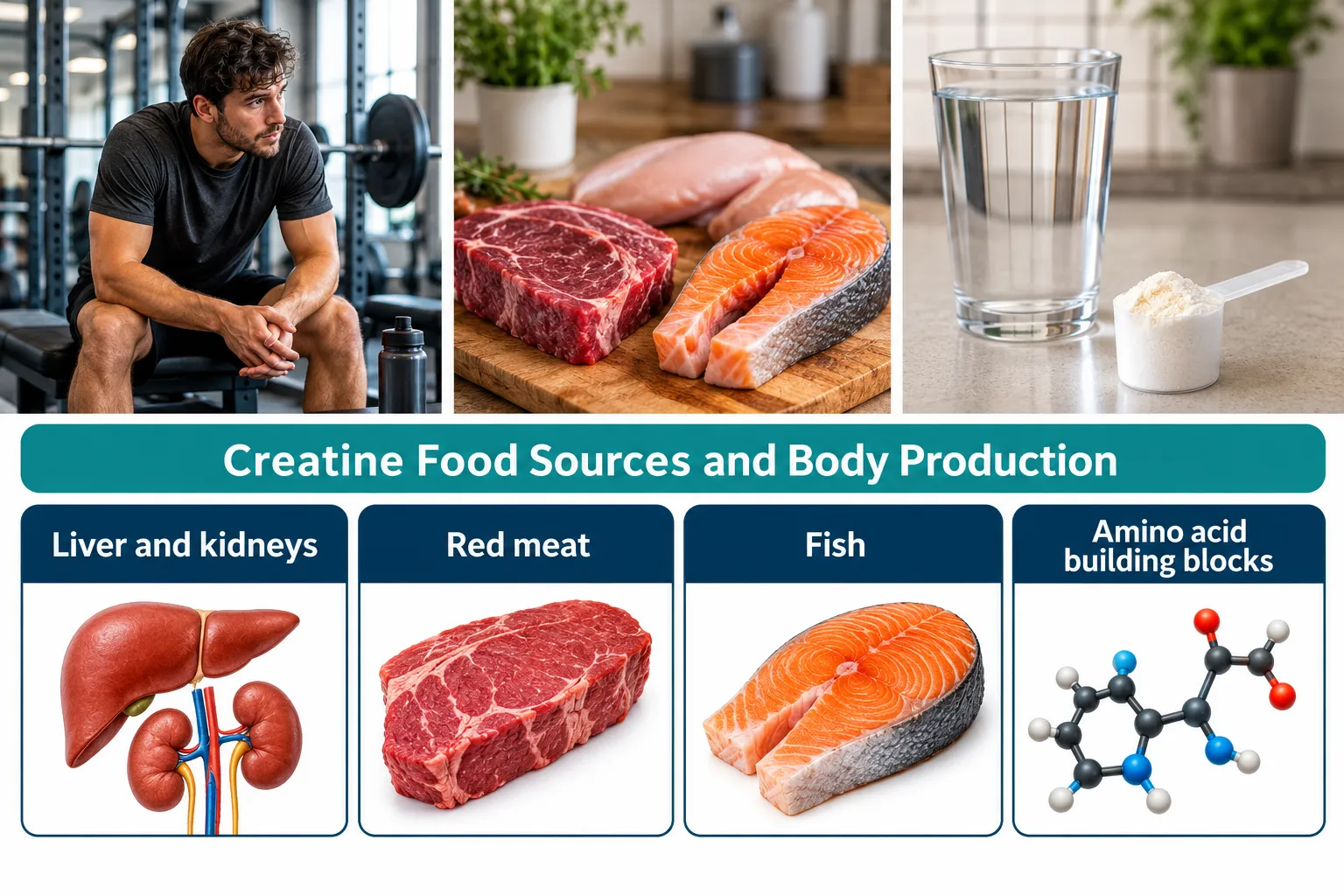
In plain English, creatine is a small molecule made from three amino acids, glycine, arginine, and methionine, that the body produces mostly in the liver and kidneys, at a rate of roughly 1 gram per day [1]. Most of it then travels to skeletal muscle, where it is stored largely as phosphocreatine, a reserve fuel tank for quick energy.

Let’s keep this practical. Think of your muscle cells as running on a currency called ATP. Cells burn through ATP fast during hard effort, and they need a way to rebuild it on the spot. Phosphocreatine is one of the quickest ways to do that, donating a phosphate group so the cell can turn ADP back into usable ATP [2]. This is not a slow metabolic pathway. It is the fast, short-burst system the body leans on during the first several seconds of intense effort, before other energy systems take over.
The simplest way to look at it is this: creatine is not fuel in the way carbohydrate or fat is fuel. It is more like a rapid-recharge mechanism for the energy you already have stored. There is no magic in it, and the mechanism itself is well established in basic physiology, even where specific outcome claims need more scrutiny.
What does creatine do during repeated high-effort exercise?
During repeated high-effort exercise, creatine’s role is to support faster regeneration of ATP, which can help you maintain output across multiple hard efforts rather than fading quickly. This is a mechanism, not a guaranteed personal outcome, individual response varies.
Here’s a practical example. Picture a set of five heavy squats, followed by two minutes of rest, then another set, and another. The first set often feels the strongest. By the third or fourth set, most lifters notice a drop in the number of reps they can complete at the same weight. Researchers have studied whether higher muscle phosphocreatine stores help blunt that drop-off across repeated sets or repeated sprints [1][3].
We need to separate fact from hype here. The mechanism, faster ATP regeneration, is well supported in exercise physiology. The outcome, better performance across repeated bouts, has been studied in humans, particularly for activities built around short, intense efforts with brief recovery, such as resistance training, sprinting, and jumping [1][3]. It depends on the conditions: the benefit shows up most clearly in short, powerful, repeated efforts, not in steady endurance activity like long-distance running or cycling at a constant pace.
A common mistake is assuming the mechanism alone proves the benefit. That is not how evidence works. The mechanism explains why a benefit is plausible; the human performance data is what confirms it actually happens in practice, and it does, specifically in repeated short, intense effort contexts [1][3].
What benefits have the clearest evidence?
The stronger evidence points to creatine supporting strength, power output, and performance during repeated bouts of high-intensity exercise, along with modest improvements in training adaptations such as lean tissue gains over time. This is where the research is most consistent.
What matters most is this: the NIH Office of Dietary Supplements states that creatine can improve performance in activities that combine intense effort with short recovery periods, while noting that individual responses vary and that it offers little benefit for pure endurance sports [1][3]. That is a measured, evidence-based summary, not a sweeping claim.
In real-world terms, people doing structured resistance training sometimes see:
- Slightly better ability to complete the last rep or two of a tough set
- Modest gains in strength measures over weeks of consistent training
- Some support for lean body mass changes when combined with resistance exercise
Recent systematic reviews support a modest added effect when creatine is paired with resistance training. That does not mean it replaces training or produces the same result for everyone; baseline training, adherence, age, and study design all matter [1][3].
Decision rule: if your main goal is strength and power development through resistance training, this is the area where the evidence base is most settled. If your main goal is marathon-style endurance, the evidence for meaningful benefit is much thinner.
What is still uncertain?

Brain health belongs in the conversation, but the evidence needs a different label. A 2024 systematic review and meta-analysis found possible improvements in selected measures such as memory and attention, while the certainty varied by outcome and the authors did not find a clear overall cognitive benefit [5].
That is a useful signal—not proof that creatine prevents cognitive decline, treats dementia, fixes brain fog, or produces the same result for every reader. The strongest claim this evidence supports is narrower: creatine is being studied for cognition, and some outcomes are promising enough to justify better trials.
Keep the two evidence buckets separate: repeated high-effort exercise and resistance training have the more established human record; cognition and healthy aging remain developing areas where the result depends on the population and outcome measured.
Where creatine comes from
Creatine comes from two sources: your own body’s production, mainly in the liver and kidneys, and your diet, mainly through meat and fish. The body makes roughly 1 gram per day on its own from glycine, arginine, and methionine [1].
Dietary creatine is found mainly in animal foods. For a broader food-first perspective, see our guide to nutrient-dense foods.
- Red meat
- Poultry
- Fish, including salmon and herring
People who eat little or no meat or fish typically have lower baseline muscle creatine stores than those who eat these foods regularly, simply because they rely more heavily on the body’s own production. This is not a diet ideology statement, it is a straightforward consequence of where dietary creatine is naturally concentrated. Context matters: a varied diet with regular meat or fish intake provides some creatine on top of what the body makes; a diet without these foods relies entirely on internal production.
Creatine for beginners
A sensible starting point for anyone new to the topic is understanding that creatine is studied alongside consistent resistance training, not instead of it. A practical first step is building a routine you can repeat; our exercise guide for better health explains the bigger picture.
Realistic expectations matter here. In real-world terms, creatine for beginners usually means:
- Noticing a small amount of early weight gain related to water retention in muscle, which is expected and not fat gain [1]
- Potentially feeling slightly more capacity to complete the last rep of a hard set over time, as training continues
- Not expecting dramatic, overnight transformation, the basics still do the heavy lifting, meaning sleep, protein intake, and consistent training remain the biggest levers
More is not always better, and creatine is not a substitute for a training plan. It may modestly support the training you are already doing consistently. If you are returning to strength work, functional strength training is a useful companion guide.
How to think about choosing a product
The simplest way to think about choosing a creatine product is to prioritize the form with the longest track record and the clearest labeling, rather than chasing newer or more expensive alternatives. Creatine monohydrate is the most studied form and carries the strongest evidence base for both performance and safety [4].
A few practical criteria, without ranking any specific brand:
- Form: Monohydrate has the deepest research history; other forms (such as buffered or micronized versions) are marketed as improvements but generally lack the same volume of long-term human evidence.
- Grams per serving: Check the label for actual grams of creatine per serving, not just the total product weight, since fillers and flavoring add bulk without adding creatine.
- Independent quality testing: Third-party testing for purity and label accuracy (from organizations that verify supplement contents) adds a layer of quality assurance, since supplements are not regulated the same way medications are.
- Simplicity: A single-ingredient product makes it easier to know exactly what you are taking, compared to blended “stacks” with multiple unlisted-dose ingredients.
Evidence first: choose based on what has data behind it, not based on marketing language like “advanced absorption” or “next generation,” which are rarely backed by head-to-head human evidence against monohydrate.
What research protocols tell us—and what they do not
Studies commonly use either a short front-loaded protocol or a steadier protocol that builds muscle stores more gradually. That describes research design, not a personal instruction. The right decision for an individual depends on health history, medications, other supplements, goals, and how a product is tolerated.
The useful takeaway is not to copy a protocol from a headline. It is to understand that timing and amount are separate questions, and both deserve a focused evidence-based guide rather than a one-size-fits-all rule.
Safety, side effects, and who should speak with a clinician
Based on current evidence, creatine has a favorable safety profile for most healthy adults when used over weeks, months, or even longer periods. The NIH reports it appears safe for long-term use across several years in healthy populations, and a sports nutrition position statement summarized safety data at higher daily amounts over multi-year use in healthy people and some patient groups [1][4].
Is creatine safe to take? For most healthy adults, the evidence suggests yes, with a good safety record built over decades of study [1][3]. That said, “safe for most healthy adults” is not the same as “safe for everyone regardless of health status,” which is why the conditions below matter.
What are the side effects of creatine? The most consistently reported change is a small increase in body weight from water held in muscle tissue, not fat [1][4]. Some people report digestive discomfort, particularly with larger or rapidly introduced amounts, but controlled evidence does not establish a consistent rise in cramping, dehydration, or kidney damage in healthy adults [1][4].
Does creatine cause hair loss? This is a commonly repeated claim, but the evidence is not strong. One older study found a hormonal change that some have linked to hair loss risk, but this has not been confirmed as a consistent, well-established effect in the broader research base. I would be careful with that claim, it is often stated with more confidence than the evidence supports.
Can you take creatine with kidney problems? People with existing kidney disease should speak with a healthcare provider before using creatine, since creatine supplementation raises blood creatinine levels, a marker doctors use to assess kidney function, without necessarily indicating actual kidney damage [1][4]. This distinction matters for anyone being monitored for kidney health, because an isolated creatinine change in a creatine user needs context, not alarm.
Can women take creatine? Women are included in the research base, although the exercise literature has historically included more men. The available evidence does not support excluding otherwise healthy women simply because of sex, while individual health context still matters [1][4].
Other groups that should speak with a clinician before starting creatine include:
- Pregnant or breastfeeding individuals, where research is limited
- People taking medications that affect kidney function
- Anyone with a diagnosed kidney or liver condition
- People managing other chronic health conditions where supplement interactions are a reasonable concern
This is not a list to self-diagnose from. It is a reminder that “generally safe for healthy adults” is a population-level statement, not a personal guarantee.
Do you need to cycle off creatine? The evidence base does not establish periodic breaks as a requirement for healthy adults. That does not replace individual medical guidance, but it does separate a common gym habit from a demonstrated safety rule [1][4].
Is creatine good for weight loss? Not in the way most people mean “weight loss.” Creatine does not burn fat, and it often causes a small increase in water-related body weight, especially early on [1]. If the goal is fat loss specifically, creatine is not the relevant tool, it is a tool for supporting strength and training performance, which can indirectly support body composition goals over time, but that is a different mechanism than weight loss itself.
Questions readers can use to decide their next topic
Clear beats clever, so here is a short list of natural next questions this introduction does not fully answer, grouped by topic so you can decide where to go next:
- What foods contain the most natural creatine, and how much would you realistically need to eat to make a difference?
- How long does creatine typically take to produce a noticeable change in training performance?
- Are there meaningful differences between creatine and protein powder, and do they serve the same purpose?
- How do different creatine formats (monohydrate, micronized, buffered) actually compare in practice?
- What does a loading-phase schedule look like in more detail, and who should consider skipping it?
- What specific side effects show up most often, and how are they managed in research settings?
These are exactly the kinds of questions a focused follow-up article can answer in more depth, once that content exists.
FAQ
What is creatine, in the simplest possible terms?
Creatine is a naturally occurring compound, made from amino acids, that your body produces and stores mostly in muscle to help regenerate energy quickly during short, intense physical effort [1][2].
Is creatine a steroid?
No. Creatine is not a steroid and does not work through the same hormonal pathways as anabolic steroids. It is a nitrogen-containing compound involved in cellular energy recycling [1].
What does creatine do for exercise performance?
Creatine supports faster regeneration of ATP in muscle cells, which research links to improved strength, power, and performance across repeated high-intensity efforts, with far less benefit for steady endurance activity [1][3].
What foods naturally contain creatine?
Red meat and fish are the main dietary sources of creatine, while the body also produces about 1 gram per day on its own from glycine, arginine, and methionine [1].
How long does creatine take to show noticeable effects?
This varies by protocol and individual, with some research designs using a short loading phase to raise muscle stores faster and others using a slower, steady daily amount. A dedicated article on this topic is planned to cover timelines in more detail.
Should I expect creatine to help with weight loss?
No. Creatine is not designed for fat loss and commonly causes a small increase in water-related body weight. Its demonstrated value is in strength and repeated high-intensity exercise performance, not weight loss [1][3].
References
- National Institutes of Health Office of Dietary Supplements. Dietary Supplements for Exercise and Athletic Performance: Health Professional Fact Sheet.
- National Center for Biotechnology Information. Creatine: PubChem Compound Summary.
- Wang Z, et al. Effects of Creatine Supplementation and Resistance Training on Muscle Strength Gains in Adults Under 50: A Systematic Review and Meta-Analysis. Nutrients. 2024.
- Kreider RB, et al. International Society of Sports Nutrition position stand: safety and efficacy of creatine supplementation in exercise, sport, and medicine. JISSN. 2017.
- Xu Y, et al. The effects of creatine supplementation on cognitive function in adults: a systematic review and meta-analysis. Frontiers in Nutrition. 2024.

About the author
Dave James is the founder of All Perfect Health. He writes practical, evidence-aware health guides that separate established findings from marketing claims. He is not a doctor, and this article is not individual medical advice.
Creatine Cluster
Pillar: YOU ARE HERE What Is Creatine and What Does It Do?
Support guides on formats, food sources, timing, side effects, and use patterns will be linked here as they are published.