
Performing Leg Lifts Exercise: Complete Guide to Form, Benefits, and Variations
In this guide
- What Exactly Are Leg Lift Exercises and What Muscles Do They Work?
- How Do You Perform Leg Lifts with Correct Form?
- What Are the Main Variations of Leg Lifts?
- What Are the Key Benefits of Performing Leg Lifts Regularly?
- How Often Should You Do Leg Lifts to See Results?
- Who Should Be Cautious About Performing Leg Lifts?
- How Do Leg Lifts Compare to Other Core and Hip Exercises?
- What Mistakes Do People Make When Performing Leg Lifts?
Last updated: March 28, 2026
Quick Answer
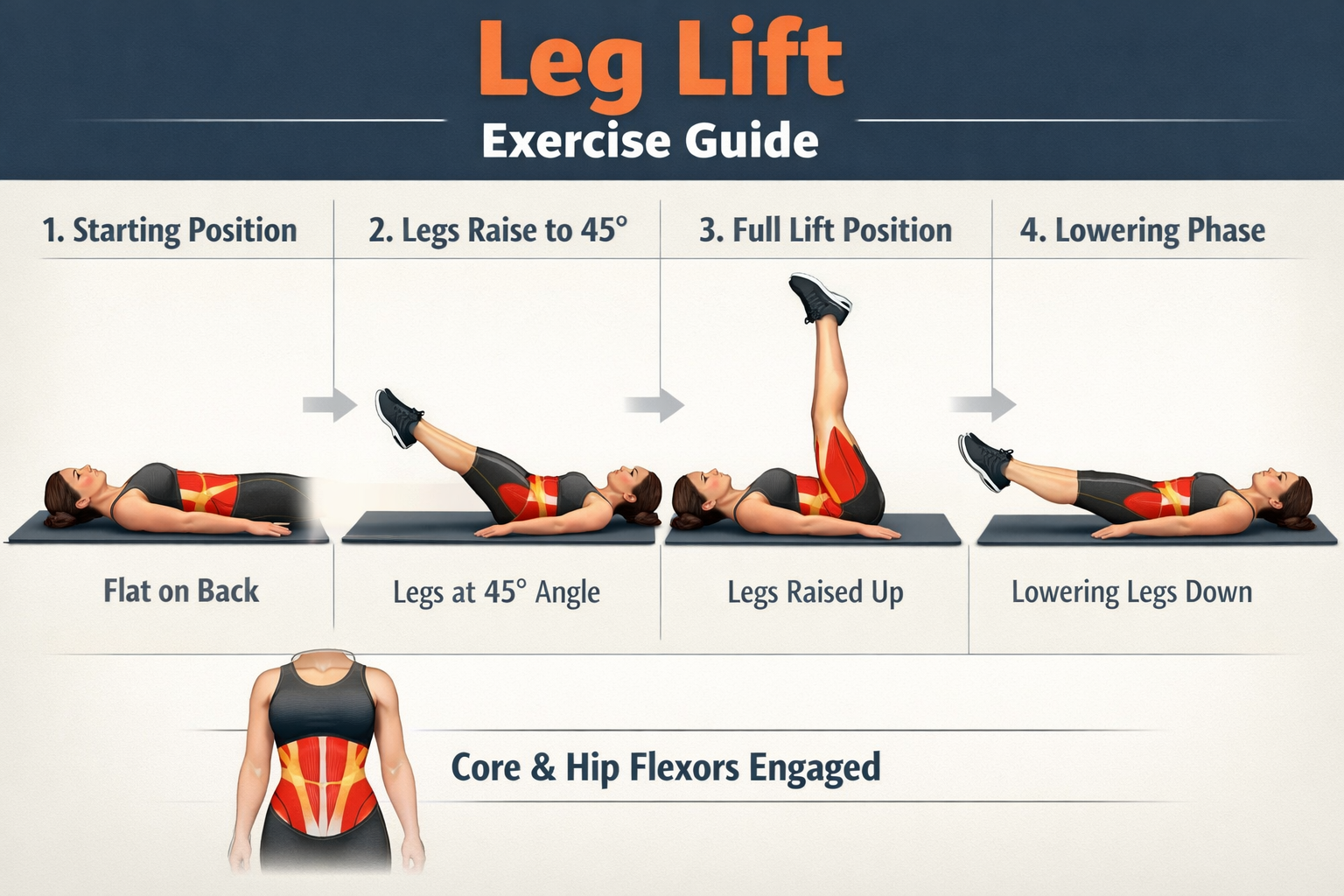
Leg lifts exercise are a bodyweight exercise that strengthens the hip flexors, lower abdominals, and quadriceps by raising one or both legs against gravity from a lying, seated, or hanging position. They require no equipment, can be performed almost anywhere, and suit beginners through advanced athletes. To perform a basic lying leg lift correctly: lie flat on your back, keep your legs straight, and raise them to roughly 90 degrees before lowering them slowly — without letting your lower back arch off the floor.
Key Takeaways
- Leg lifts primarily target the hip flexors and lower abdominals, with secondary engagement of the quadriceps and hamstrings
- Proper form requires a neutral or pressed lower back — allowing your lumbar spine to arch is the most common mistake and the main cause of lower-back discomfort
- There are at least five major variations: lying, hanging, seated, side-lying, and weighted — each with a different difficulty level and muscle emphasis
- Beginners should start with 3 sets of 8–10 reps, progressing to 15–20 reps before adding resistance
- Leg lifts improve functional strength for everyday movements like climbing stairs, standing from a seated position, and walking on inclines
- People with active lower-back injuries, recent abdominal surgery, or hernias should avoid or modify this exercise and consult a doctor first
- Performing leg lifts three times per week is a reasonable starting frequency for noticeable strength gains within four to six weeks
- Adding ankle weights or resistance bands increases the challenge without changing the movement pattern significantly
- Leg lifts pair well with planks, glute bridges, and good morning exercises for a balanced lower-body and core routine
- Pregnant women should consult their doctor before performing leg lifts and may need to modify to single-leg variations
What Exactly Are Leg Lift Exercises and What Muscles Do They Work?
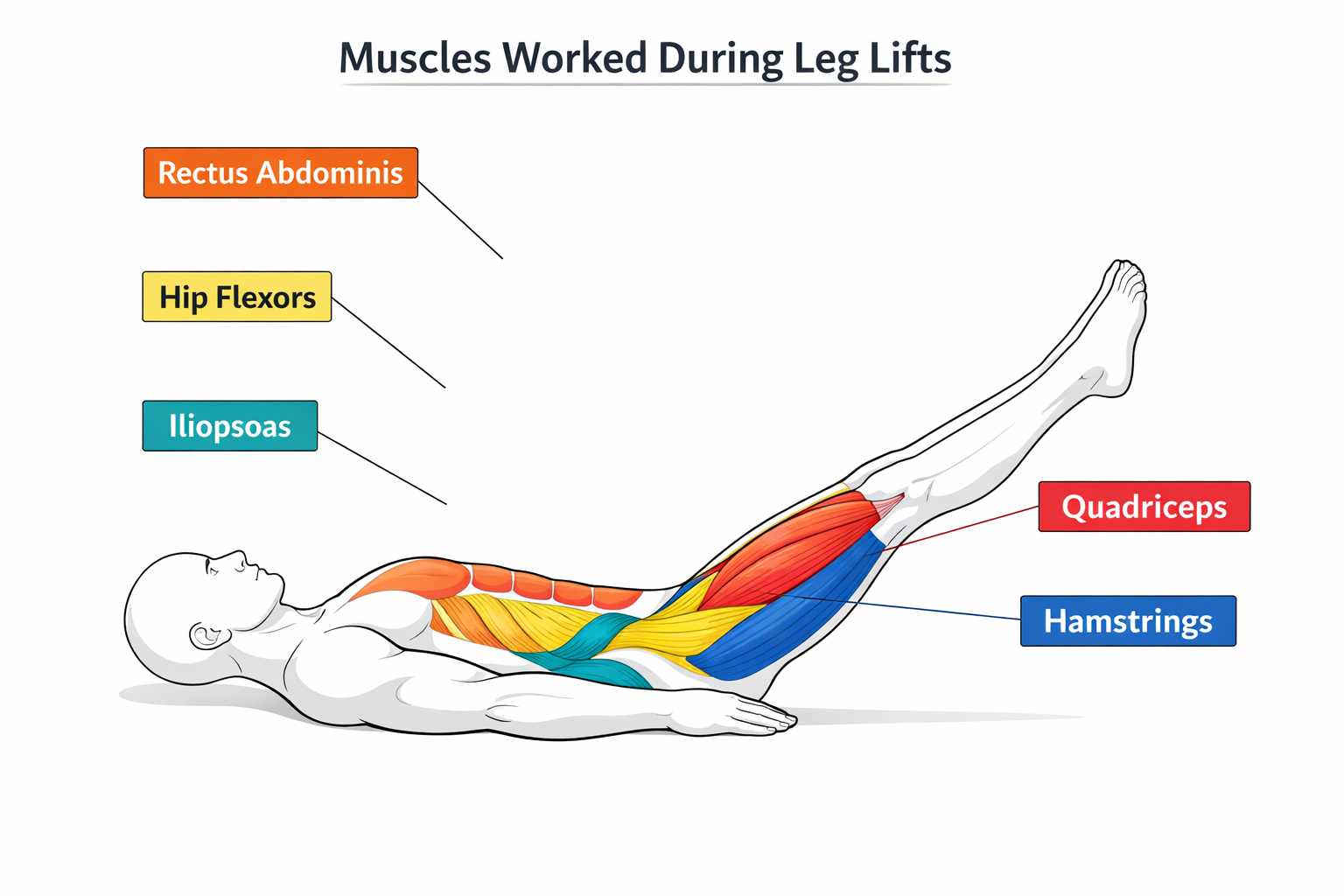
Leg lifts are a compound bodyweight movement that uses gravity as resistance. When you raise your legs, your hip flexors — primarily the iliopsoas — do most of the work, while your lower abdominals stabilize your pelvis and spine throughout the movement.
Primary muscles worked:
- Iliopsoas (hip flexors): The main driver of the upward movement
- Rectus abdominis (lower portion): Stabilizes the pelvis and prevents lumbar arching
- Quadriceps: Keep the knees extended during the lift
Secondary muscles worked:
- Hamstrings: Engaged isometrically to maintain leg position
- Tensor fasciae latae: Assists hip flexion
- Transverse abdominis: Deep core stabilizer activated throughout
Unlike crunches or sit-ups, leg lifts place the load below the pelvis rather than above it. This makes them particularly effective for building functional hip flexor strength — the kind you use every time you climb stairs, walk uphill, or stand up from a chair.
How Do You Perform Leg Lifts with Correct Form?
Correct form is what separates a productive leg lift from one that strains your lower back. The key principle: your lumbar spine should stay in contact with the floor (or as close to it as possible) throughout the entire movement.
Step-by-Step: Lying Leg Lift (Beginner)
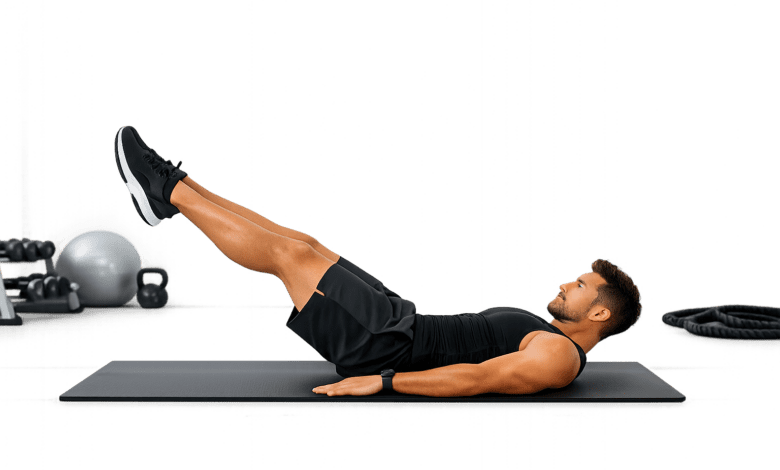
- Set up: Lie flat on your back on a firm surface — a yoga mat works well. Extend your legs fully and place your arms flat at your sides, palms facing down.
- Engage your core: Before lifting, press your lower back gently into the floor by tightening your abdominals. This is your foundation for the entire set.
- Lift your legs: Keeping both legs straight and together, raise them slowly until they are perpendicular to the floor (roughly 90 degrees). Exhale as you lift.
- Hold briefly: Pause at the top for one to two seconds.
- Lower with control: Inhale and lower your legs slowly back toward the floor. Stop just before your heels touch down — this keeps tension on the muscles and makes the exercise significantly more effective.
- Repeat: Aim for 8–10 reps per set to start.
Common mistake to avoid: Letting your lower back arch away from the floor as your legs descend. If this happens, you’ve gone too far. Either stop the descent higher (at 30–45 degrees) or bend your knees slightly to reduce the lever arm.
Progression Tip
If keeping both legs straight is too difficult, start with bent knees. Once you can complete 3 sets of 15 reps with bent knees and no lower-back discomfort, progress to straight legs.
What Are the Main Variations of Leg Lifts?
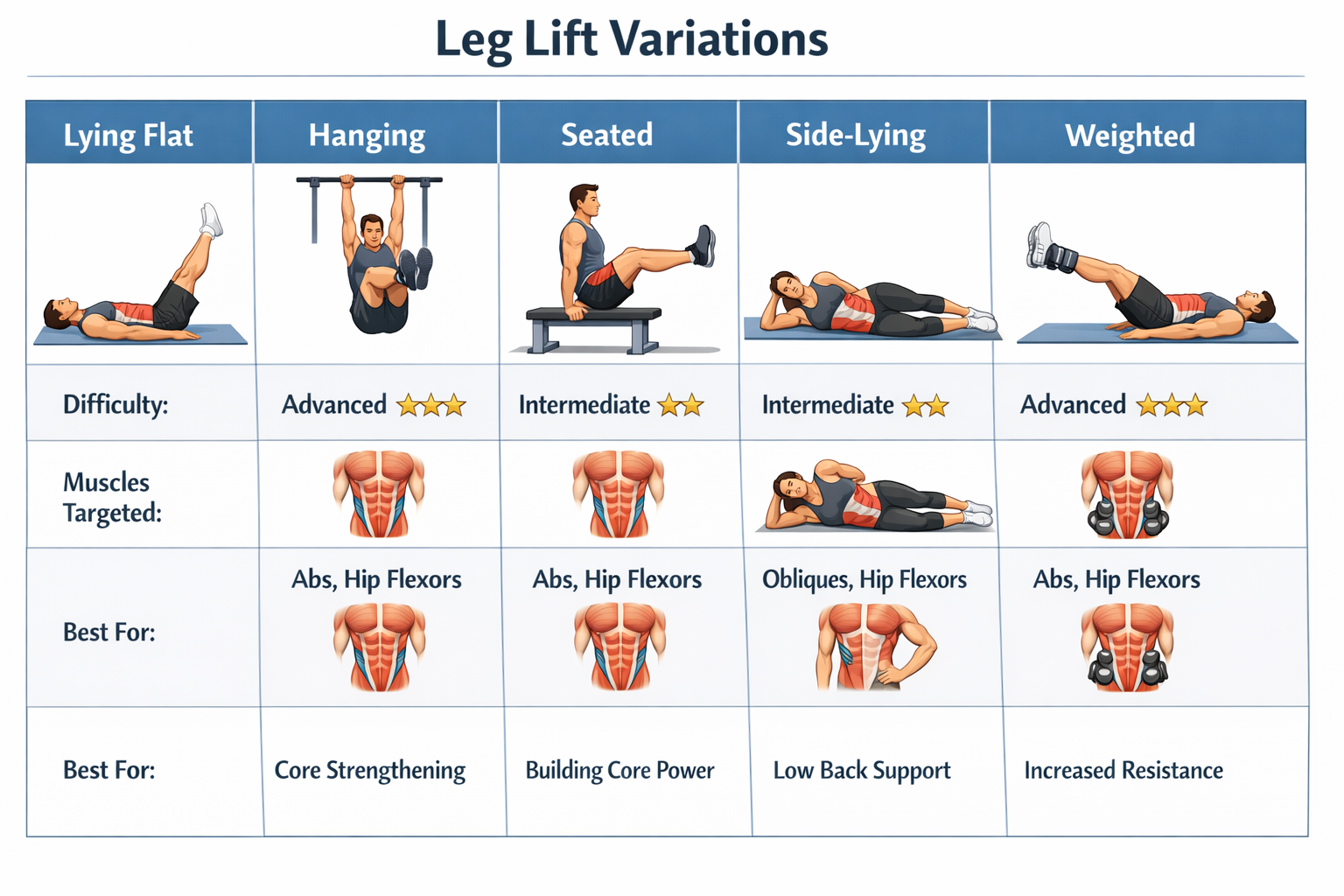
Once you’ve mastered the basic lying leg lift, there are several variations worth adding to your routine. Each one shifts the difficulty or muscle emphasis in a meaningful way.
1. Hanging Leg Raises
Performed from a pull-up bar or captain’s chair. Because your upper body is suspended, your core has to work much harder to stabilize. This is considered an advanced variation and one of the most effective exercises for overall core and hip flexor development.
2. Seated Leg Lifts
Sit upright in a chair with your back straight and feet flat on the floor. Extend one leg until it’s parallel to the floor, hold for two to three seconds, then lower it. This variation is excellent for older adults, people recovering from injury, or anyone who needs a low-impact option.
3. Side-Lying Leg Lifts
Lie on your side with your legs stacked. Raise your top leg toward the ceiling, hold briefly, then lower with control. This targets the hip abductors (gluteus medius and minimus) rather than the hip flexors — a useful distinction for people working on hip stability and knee health. If knee discomfort is a concern, this variation is gentler than the lying version; you might also explore exercise bikes for knee issues as a complementary low-impact option.
4. Weighted Leg Lifts
Add ankle weights (starting at 1–2 lbs) to the standard lying leg lift. This increases the load on the hip flexors without changing the movement pattern. Resistance bands anchored at the ankles work equally well and allow for more gradual load increases.
5. Flutter Kicks
From the lying position, alternate raising each leg in a small, rapid scissoring motion. This keeps constant tension on the hip flexors and lower abs and is a staple in swimming and military training programs.
Choose the variation that fits your goal:
- Building core stability from scratch → Bent-knee lying leg lift
- Targeting hip abductors for knee and hip health → Side-lying leg lift
- Maximum core challenge → Hanging leg raise
- Low-impact option for older adults or rehab → Seated leg lift
- Adding progressive overload → Weighted or banded lying leg lift
What Are the Key Benefits of Performing Leg Lifts Regularly?
Leg lifts deliver several well-documented physical benefits when performed consistently. Here’s what you can realistically expect.
Stronger Hip Flexors and Core
The hip flexors are among the most-used muscle groups in daily life, yet they’re chronically weak in people who sit for long periods. Regularly performing leg lifts builds the functional strength needed for walking, running, and any activity that requires lifting your legs — including skiing exercises that demand powerful hip drive.
Improved Lower-Abdominal Strength
The lower portion of the rectus abdominis is notoriously difficult to isolate. Leg lifts, when performed with a pressed lower back, create significant demand on this area. Over time, this contributes to a stronger, more stable midsection.
Better Circulation
The rhythmic contraction and relaxation of large muscle groups during leg lifts promotes venous return — the movement of blood back toward the heart. This is particularly beneficial for people who sit or stand for extended periods. Pairing regular exercise with an anti-inflammatory diet can further support circulation and reduce exercise-related inflammation.
Improved Balance and Functional Mobility
Single-leg variations and side-lying leg lifts challenge your stabilizing muscles, which contributes to better balance over time. For older adults, this is especially valuable — stronger hip flexors and better balance are directly linked to reduced fall risk.
Flexibility and Range of Motion
Moving your legs through a full range of motion regularly helps maintain and gradually improve hip flexibility. This matters for anyone whose daily routine involves prolonged sitting, which tends to shorten the hip flexors over time.
How Often Should You Do Leg Lifts to See Results?
Three sessions per week is a practical and effective starting frequency for most people. This allows adequate recovery between sessions while providing enough stimulus for strength adaptation.
A simple progression framework:
| Week | Sets | Reps | Notes |
|---|---|---|---|
| 1–2 | 2 | 8–10 | Focus on form, no lower-back arching |
| 3–4 | 3 | 10–12 | Add a 2-second hold at the top |
| 5–6 | 3 | 12–15 | Slow the lowering phase to 3–4 seconds |
| 7–8 | 3 | 15–20 | Consider adding ankle weights or progressing to a harder variation |
Most people notice meaningful improvements in hip flexor strength and core stability within four to six weeks of consistent practice. Visible changes in muscle tone take longer and depend heavily on overall body composition, which is influenced by both exercise and nutrition. If weight management is also a goal, pairing this routine with healthy meals for weight loss supports faster progress.
Who Should Be Cautious About Performing Leg Lifts?
Leg lifts are safe for most healthy adults, but certain situations call for caution or modification.
Avoid or modify leg lifts if you:
- Have an active lower-back injury or chronic lumbar pain (the lever arm created by straight legs places significant stress on the lumbar spine)
- Have had abdominal surgery or a hernia in the recent past
- Are in the second or third trimester of pregnancy (consult your doctor; single-leg seated variations are often a safer alternative)
- Experience sharp hip flexor pain during the movement (this may indicate hip impingement or a flexor strain)
If you have mild lower-back discomfort, try bending your knees to 90 degrees during the lift. This shortens the lever arm and dramatically reduces lumbar stress while still engaging the hip flexors and core.
Edge case: People with very tight hip flexors (common in desk workers) sometimes experience anterior pelvic tilt during leg lifts, which can worsen lower-back discomfort. In this case, prioritizing hip flexor stretching before and after the exercise — and strengthening the glutes with exercises like bridges — is more productive than pushing through discomfort.
How Do Leg Lifts Compare to Other Core and Hip Exercises?
Leg lifts are effective, but they’re not the only option. Here’s how they stack up against common alternatives.
| Exercise | Primary Target | Equipment Needed | Difficulty | Best For |
|---|---|---|---|---|
| Lying leg lift | Hip flexors, lower abs | None | Beginner–Intermediate | Core stability, hip strength |
| Hanging leg raise | Hip flexors, full core | Pull-up bar | Advanced | Maximum core challenge |
| Plank | Transverse abdominis, full core | None | Beginner–Intermediate | Isometric core endurance |
| Bicycle crunch | Obliques, rectus abdominis | None | Beginner–Intermediate | Rotational core strength |
| Glute bridge | Glutes, hamstrings | None | Beginner | Posterior chain, lower back support |
| Dead bug | Deep core, coordination | None | Beginner–Intermediate | Core stability with limb movement |
Leg lifts fill a specific niche: they’re one of the few bodyweight exercises that directly load the hip flexors through a significant range of motion. For a well-rounded lower-body and core routine, combine them with glute bridges (posterior chain), planks (isometric stability), and swimming or cycling for cardiovascular conditioning.
What Mistakes Do People Make When Performing Leg Lifts?
Most problems with leg lifts come down to a handful of recurring errors.
1. Letting the lower back arch
This is the most common and most consequential mistake. When the lower back lifts off the floor, the lumbar spine is under load in an extended position — a setup for discomfort or injury. Fix: press your lower back into the floor before and during the movement.
2. Dropping the legs too fast
Momentum, not muscle, does the work when you let your legs fall. The lowering phase (eccentric) is where a significant portion of strength development happens. Lower your legs in three to four seconds.
3. Holding your breath
Exhale on the way up, inhale on the way down. Breath-holding increases intra-abdominal pressure unnecessarily and reduces your endurance within a set.
4. Starting with too many reps
Doing 50 reps with poor form is less productive than doing 10 reps with perfect form. Start conservatively and build.
5. Skipping the warm-up
Cold hip flexors are more prone to strain. A five-minute warm-up — light walking, leg swings, or dynamic hip circles — prepares the muscles and connective tissue for the load.
Frequently Asked Questions About Leg Lift Exercises
Q: Can leg lifts help reduce belly fat?
A: No exercise spot-reduces fat from a specific area. Leg lifts strengthen the muscles underneath the abdominal fat, but fat loss comes from a consistent calorie deficit over time. Combining leg lifts with cardio and a balanced diet is the effective approach.
Q: How long does it take to see results from leg lifts?
A: Most people notice improved hip flexor strength and core stability within four to six weeks of training three times per week. Visible muscle tone changes take longer — typically eight to twelve weeks — and depend on body composition and diet.
Q: Are leg lifts the same as leg raises?
A: The terms are often used interchangeably. Some coaches distinguish them by position (leg raises typically refer to the hanging version; leg lifts to the lying version), but there’s no universal standard. The movement pattern is the same.
Q: Can I do leg lifts every day?
A: You can, but it’s not necessary and may slow progress if your muscles don’t get adequate recovery time. Three to four sessions per week with rest days in between is more effective for building strength than daily training.
Q: Do leg lifts work the glutes?
A: Minimally. The lying leg lift primarily targets the hip flexors and lower abs. Side-lying leg lifts engage the gluteus medius more directly. For significant glute development, add glute bridges or squats to your routine.
Q: Are leg lifts safe during pregnancy?
A: In the first trimester, lying leg lifts are generally considered safe for women with uncomplicated pregnancies, but always consult your doctor first. As pregnancy progresses, lying flat on your back for extended periods is not recommended. Seated single-leg lifts are a safer alternative in later trimesters.
Q: What’s the difference between leg lifts and flutter kicks?
A: Flutter kicks are a dynamic, alternating variation of the leg lift. Instead of raising both legs together and lowering them, you alternate legs in a rapid scissoring motion. Flutter kicks maintain constant tension on the hip flexors and are often used for muscular endurance rather than strength.
Q: Should I feel leg lifts in my lower back?
A: You should not feel significant strain or pain in your lower back. Mild fatigue in the lumbar area can occur, but sharp or persistent pain is a sign that your lower back is compensating for weak hip flexors or core — or that your form needs correction. Bend your knees to reduce the load if this happens.
Q: Can leg lifts improve posture?
A: Yes, indirectly. Stronger hip flexors and a more stable core support better pelvic alignment, which contributes to improved standing and sitting posture over time — especially for people who sit for most of the day.
Q: How many leg lifts should a beginner do?
A: Start with 2 sets of 8–10 reps with a focus on controlled form. This is enough stimulus to begin building strength without overdoing it. Progress to 3 sets of 12–15 reps over the following two to three weeks.
This article is for informational purposes only and does not constitute medical advice. Consult a qualified healthcare provider before beginning any new exercise program, particularly if you have a pre-existing condition or injury.
*** More great articles that may be of interest to you 🙂
7 Best Body Composition Exercises to Build Muscle and Burn Fat
Learn more information about leg lifts exercise, Read this article: How To Do Leg Raises | Benefits, Instructions & Variations

Dave James has spent 30+ years reading health and longevity research, and has run All Perfect Health for the past five. His background is in Australian mining and industrial engineering — disciplines built on questioning claims, measuring outcomes, and respecting evidence. He writes about what the research actually says, including where the experts disagree.
More about Dave & this site →