
10 Best Exercises for Skiing: Build Strength, Balance, and Endurance Before You Hit the Slopes
In this guide
- Why Do Skiers Need Specific Exercise Training?
- What Are the Best Lower-Body Exercises for Skiing?
- What Core Exercises Help Most with Skiing?
- What Upper-Body Exercises Should Skiers Include?
- What Cardio Training Is Best for Skiers?
- How Should You Structure a Ski Conditioning Program?
- What Should You Do to Warm Up Before Skiing?
- What Mistakes Do Skiers Make When Training Off the Mountain?
Last updated: March 28, 2026
Quick Answer
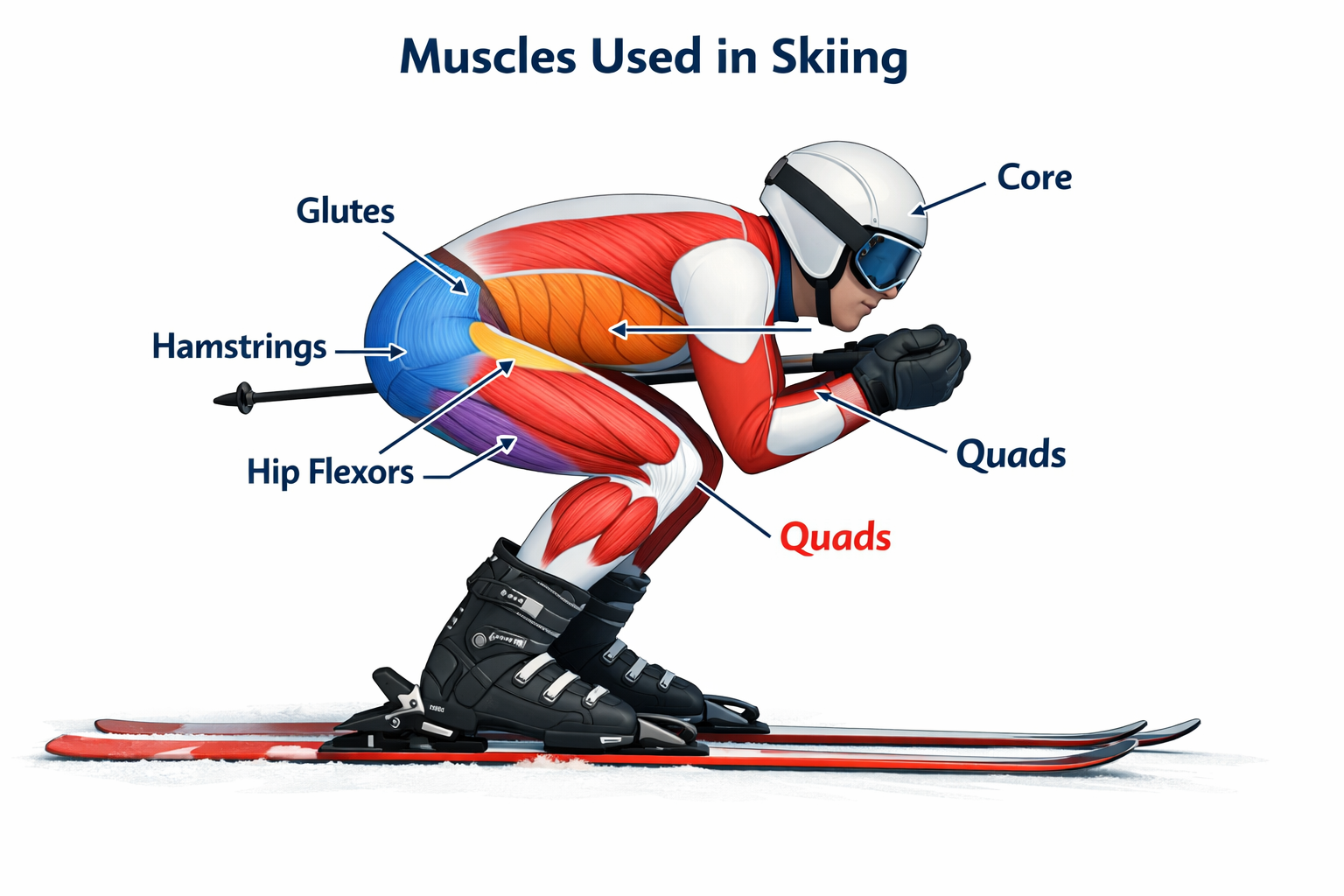
The best exercises for skiing target your quadriceps, glutes, hamstrings, core, and hip stabilizers — the exact muscle groups that keep you controlled and injury-free on the mountain. A well-rounded ski conditioning program combines lower-body strength work (squats, lunges, wall sits), core stability (planks, side planks), and cardiovascular endurance (cycling, rowing, interval training). Start training at least 6–8 weeks before your ski trip for meaningful results.
Key Takeaways
- Skiing demands strength from your quads, glutes, hamstrings, calves, and core simultaneously — your training should reflect that
- Pistol squats and lateral lunges are among the most ski-specific exercises because they mimic the single-leg loading and lateral movement of skiing
- Wall sits are an underrated but highly effective way to build quad endurance for long runs
- Core stability — not just core strength — is what separates controlled skiers from fatigued ones; side planks with leg raises train exactly that
- Cardiovascular fitness determines how long you can ski before form breaks down; cycling and rowing are particularly ski-friendly cardio options
- Burpees and jump squats build explosive power that helps with moguls, quick direction changes, and absorbing terrain
- A proper warm-up (5–10 minutes of light cardio plus dynamic stretching) before skiing significantly reduces injury risk
- Begin a dedicated ski conditioning program 6–8 weeks before your first day on the mountain
- Recovery matters: anti-inflammatory nutrition and adequate sleep support muscle repair between training sessions
- Beginners should prioritize bodyweight mastery before adding load; advanced skiers can add resistance bands or weights to most of these movements
Why Do Skiers Need Specific Exercise Training?
Skiing places unique demands on your body that general fitness doesn’t fully address. The sport requires sustained isometric strength (holding a bent-knee position for extended periods), explosive lateral power, and constant core engagement to absorb uneven terrain. Without targeted preparation, even reasonably fit people find skiing exhausting — and injury-prone.
The most common skiing injuries — ACL tears, knee sprains, and hip flexor strains — are frequently linked to muscular fatigue and imbalance rather than pure accidents. Training the right muscles in the right patterns before you ski is one of the most practical things you can do to protect yourself and ski better.
Who this guide is for: Recreational and intermediate skiers who want to improve performance and reduce injury risk. The exercises below are appropriate for most fitness levels, with modifications noted where relevant.
What Are the Best Lower-Body Exercises for Skiing?
Lower-body strength is the foundation of good skiing. Your quads bear the brunt of the load in a ski stance, while your glutes and hamstrings provide the power and stability for turns, stops, and absorbing bumps.
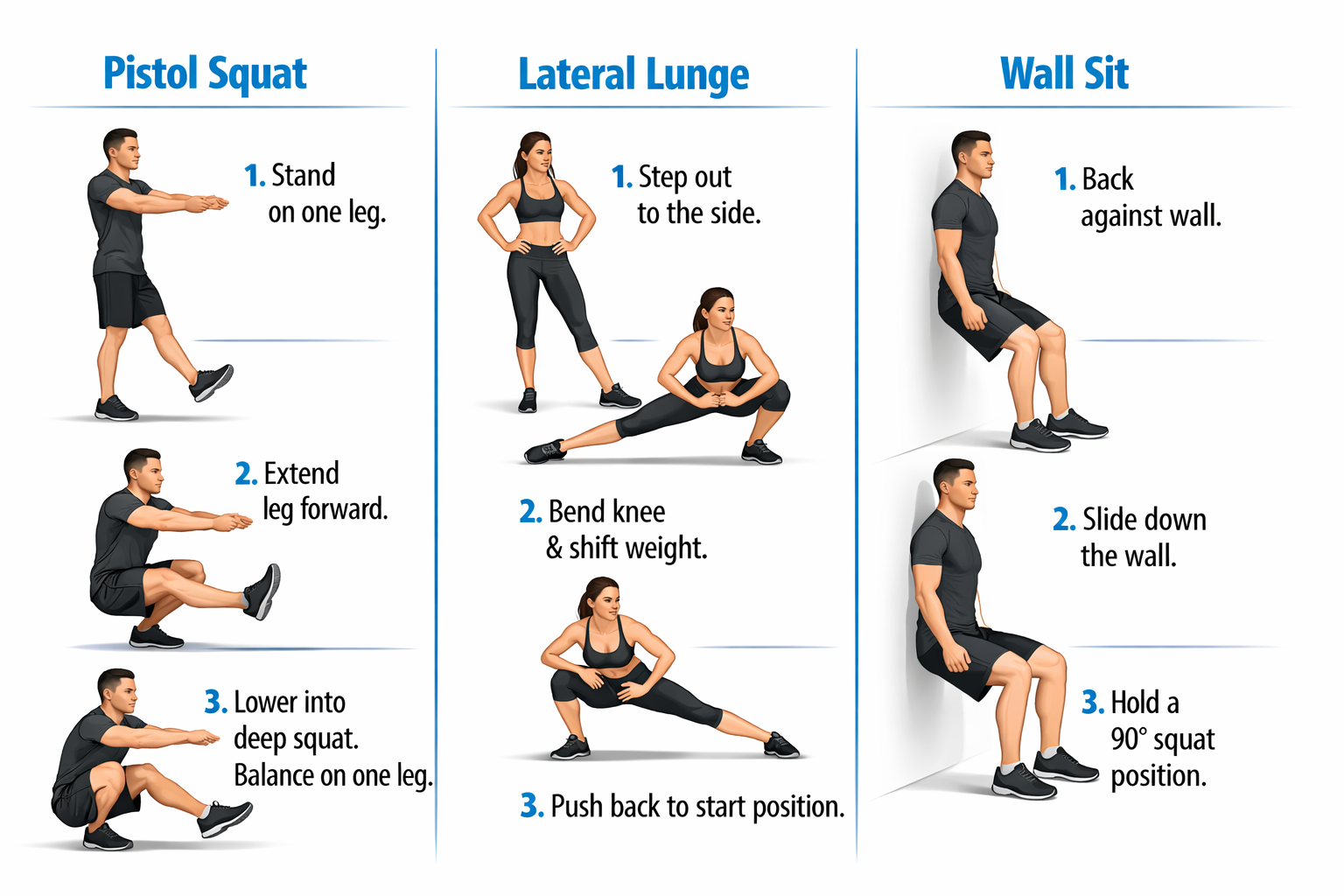
1. Pistol Squats
A pistol squat is a single-leg squat performed with the non-working leg extended forward off the ground. It’s one of the most ski-specific exercises available because skiing is fundamentally a single-leg sport — each turn loads one leg more than the other.
How to do it:
- Stand on one foot with the other leg extended straight in front of you
- Slowly lower yourself by bending the standing knee, keeping your chest upright and heel flat
- Descend as low as your mobility allows — ideally until your thigh is parallel to the floor
- Drive through the heel to return to standing
- Aim for 3 sets of 5–8 reps per leg
Modification for beginners: Hold a doorframe or TRX strap for balance support, or perform a Bulgarian split squat (rear foot elevated on a bench) as a stepping stone.
Common mistake: Letting the knee cave inward on the descent. Focus on pushing the knee out over the pinky toe throughout the movement.
2. Lateral Lunges
Lateral lunges train the hip abductors and adductors — muscles that control side-to-side movement. These are critical for edge control and carving turns.
How to do it:
- Stand with feet together
- Step one foot wide to the side, bending that knee while keeping the opposite leg straight
- Push your hips back as you lower — don’t let the knee travel past the toes
- Drive off the bent leg to return to the start position
- Perform 3 sets of 10–12 reps per side
Add difficulty: Hold a dumbbell at your chest or add a resistance band around your thighs.
3. Wall Sits
Wall sits are simple but brutally effective for building quad endurance — the kind you need to hold a ski stance for a full run without your legs burning out.
How to do it:
- Stand with your back flat against a wall
- Slide down until your thighs are parallel to the floor (90-degree knee angle)
- Hold for 30–60 seconds, building toward 90 seconds over several weeks
- Rest 60 seconds between sets; perform 3–4 sets
Choose this exercise if you’re a beginner or returning from a knee injury — it’s lower-impact than squats while still building meaningful quad endurance.
4. Jump Squats
Explosive power helps skiers absorb moguls, recover from unexpected terrain, and generate speed through turns. Jump squats build that power in the exact muscles skiing demands.
How to do it:
- Stand with feet shoulder-width apart
- Lower into a squat until thighs are parallel to the floor
- Explode upward, leaving the ground completely
- Land softly with bent knees to absorb impact
- Immediately lower into the next rep
- Perform 3 sets of 8–10 reps
Edge case: If you have knee pain, replace jump squats with step-ups onto a box — you still build single-leg power without the impact load.
What Core Exercises Help Most with Skiing?
Core stability is what keeps a skier upright and in control when terrain gets unpredictable. The core in skiing isn’t just the abs — it includes the obliques, hip flexors, and the muscles that connect the upper and lower body during rotation.
5. Side Plank with Leg Raises
The side plank targets the obliques and hip abductors simultaneously, making it one of the most ski-relevant core exercises available. Adding a leg raise increases glute activation and challenges hip stability further.
How to do it:
- Lie on your side, propped up on one forearm with feet stacked
- Lift your hips off the ground so your body forms a straight line from head to heel
- Hold the position, then slowly raise the top leg 12–18 inches and lower it
- Perform 10–12 leg raises per side, then hold the plank for an additional 20–30 seconds
- Complete 3 sets per side
Modification: Perform the side plank from the knee rather than the foot if the full version is too challenging initially.
6. Plank Variations
A standard plank builds the anterior core stability that keeps your torso from collapsing forward in a ski stance. For skiers, adding movement to a plank — such as shoulder taps or alternating leg lifts — more closely mimics the dynamic demands of the mountain.
Recommended plank progression for skiers:
- Week 1–2: Standard forearm plank, 3 x 30–45 seconds
- Week 3–4: High plank with shoulder taps, 3 x 10 taps per side
- Week 5–6: Plank with alternating leg lifts, 3 x 10 reps per side
7. Rotational Medicine Ball Throws
Skiing involves significant rotational forces through the torso, especially during aggressive turns and mogul skiing. Medicine ball rotational throws train this movement pattern under load.
How to do it:
- Stand sideways to a wall, holding a medicine ball (4–8 kg)
- Rotate away from the wall, then explosively rotate back and throw the ball against the wall
- Catch the rebound and immediately repeat
- Perform 3 sets of 10 throws per side
What Upper-Body Exercises Should Skiers Include?
Upper-body training for skiing is often overlooked, but it matters more than most people expect. Pole planting requires shoulder stability and tricep endurance. Catching yourself in a fall — or getting up from one — demands functional pushing strength.
8. Push-Ups
Push-ups build functional pressing strength in the chest, shoulders, and triceps. For skiers, they’re most valuable for fall recovery and pole-planting endurance on long runs.
How to do it:
- Start in a high plank position, hands slightly wider than shoulder-width
- Lower your chest toward the floor, keeping elbows at roughly 45 degrees from the body
- Push back up to the start position with full arm extension
- Perform 3 sets of 10–20 reps depending on fitness level
Progression options:
- Easier: Incline push-ups with hands on a bench
- Harder: Add a resistance band across the upper back, or elevate the feet on a bench
- Ski-specific variation: Perform push-ups on an unstable surface (like a BOSU ball) to engage stabilizer muscles
9. Dips
Dips target the triceps, anterior deltoids, and lower chest — all relevant for pole planting and pushing yourself up after a fall.
How to do it:
- Grip parallel bars (or the edge of a sturdy bench) with arms straight
- Lower your body by bending the elbows to roughly 90 degrees
- Push back up to the start position
- Perform 3 sets of 8–12 reps
Note: Dips place significant load on the shoulder joint. If you have a history of shoulder problems, substitute with tricep pushdowns using a resistance band.
What Cardio Training Is Best for Skiers?
Cardiovascular fitness determines how long you can ski before fatigue compromises your form — and your safety. When your legs and lungs give out, injury risk rises sharply. The best cardio for skiers mimics the intermittent, high-intensity nature of skiing: short bursts of hard effort followed by recovery.
10. Burpees and Interval Training
Burpees are one of the most efficient conditioning exercises for skiers because they combine lower-body power, upper-body strength, and cardiovascular demand in a single movement.
Standard burpee:
- From standing, drop your hands to the floor
- Jump or step your feet back to a push-up position
- Perform one push-up
- Jump or step feet back to your hands
- Explosively jump upward with arms overhead
- Perform 3–5 rounds of 10 reps with 60 seconds rest between rounds
Other effective cardio options for skiers:
| Exercise | Why It Works for Skiing | Frequency |
|---|---|---|
| Cycling (stationary or road) | Builds quad endurance in a ski-like position | 2–3x per week |
| Rowing machine | Full-body conditioning, strong core demand | 2x per week |
| Stair climbing | Directly loads the same muscles as skiing | 2–3x per week |
| Running (especially trail) | General cardiovascular base, hip stability | 2–3x per week |
| Swimming | Low-impact recovery cardio, shoulder strength | 1–2x per week |
For interval training, a simple protocol is: 30 seconds of maximum effort followed by 90 seconds of easy movement, repeated 8–10 times. This mirrors the effort pattern of a ski run better than steady-state cardio alone. You can also track your fat burn heart rate to make sure you’re training in the right zone for your goals.
How Should You Structure a Ski Conditioning Program?

A 6-week program is enough to produce meaningful improvements in ski-specific fitness for most recreational skiers. The key is progressive overload — gradually increasing difficulty so your body adapts without breaking down.
Sample weekly structure (6 weeks out from your ski trip):
- Monday: Lower-body strength (pistol squats, lateral lunges, wall sits, jump squats) — 45 minutes
- Tuesday: Cardio intervals (cycling or rowing) — 30–40 minutes
- Wednesday: Core and upper body (side planks, push-ups, dips, medicine ball throws) — 40 minutes
- Thursday: Active recovery (walking, light swimming, mobility work)
- Friday: Full-body circuit (burpees, jump squats, push-ups, side planks) — 35–45 minutes
- Saturday: Longer steady-state cardio (45–60 minutes cycling, running, or stair climbing)
- Sunday: Rest
Progression rule: Increase difficulty (reps, sets, or load) by roughly 10% per week. Don’t increase all three variables at once.
Supporting your training with good nutrition matters too. Anti-inflammatory foods can help manage exercise-related soreness and support faster recovery — worth considering if you’re training hard in the weeks before a ski trip.
What Should You Do to Warm Up Before Skiing?
A proper warm-up before skiing reduces injury risk and improves your first-run performance. Cold muscles and stiff joints are more vulnerable to sprains and tears, especially in the knees and ankles.
Recommended pre-ski warm-up (10–15 minutes):
- Light cardio (5 minutes): Brisk walking, easy jogging in place, or a few minutes on a stationary bike in the lodge
- Leg swings (front-to-back and side-to-side): 10 reps per leg — loosens the hip flexors and adductors
- Bodyweight squats: 15 slow reps, focusing on full range of motion
- Lateral lunges: 8 reps per side
- Ankle circles: 10 rotations each direction per ankle
- Torso rotations: 10 reps each direction — activates the rotational core muscles used in turns
Avoid static stretching (holding a stretch for 30+ seconds) before skiing. Research consistently shows static stretching before activity can temporarily reduce power output. Save it for your post-ski cooldown.
What Mistakes Do Skiers Make When Training Off the Mountain?
Skipping single-leg work. Most gym-goers default to bilateral exercises (regular squats, leg press). Skiing is asymmetrical — each leg works independently. Include at least one single-leg exercise per lower-body session.
Neglecting hip stability. Weak hip abductors lead to knee valgus (knees caving inward) under load — a common cause of ACL stress in skiers. Lateral band walks and clamshells are simple, effective fixes.
Only training strength, not endurance. A single ski run can last 3–5 minutes of continuous muscular effort. Training with low reps and heavy weight alone won’t prepare your muscles for that duration. Include higher-rep sets (15–20 reps) and timed holds (wall sits, planks) in your program.
Ignoring the upper body entirely. Pole planting and fall recovery both require functional upper-body strength. Even two upper-body sessions per week makes a noticeable difference.
Starting too late. Beginning a training program one week before your trip produces minimal adaptation. The body needs at least 4–6 weeks to show meaningful strength and endurance gains.
📂 The Complete Guide to Sport-Specific Training
This article is part of the APH cluster. Use the links below to move between the pillar and child articles.
- Read the pillar: The Complete Guide to Sport-Specific Training: How to Prepare Your Body for Any Activity (2026)
- → Hiking and Backpacking Fitness: Build Leg Endurance and Protect Your Joints on the Trail
- → Tennis and Pickleball Conditioning for Adults 50+: Agility, Shoulder Health, and Reaction Speed
- → Cycling Fitness: Build Leg Power, Core Stability, and Endurance on the Bike
- → Strength Training for Runners: Prevent Injury and Build Speed
- → Best Exercises for Golf: Rotation, Power, and Back Protection
- YOU ARE HERE 10 Best Exercises for Skiing: Build Strength, Balance, and Endurance Before You Hit the Slopes
Frequently Asked Questions
How far in advance should I start training for a ski trip?
Start at least 6–8 weeks before your trip. This gives your body enough time to adapt to the training stimulus. Four weeks is the minimum for noticeable improvement; anything less is mostly just getting sore.
Can beginners do these exercises?
Yes. Most exercises have beginner modifications — wall sits instead of pistol squats, incline push-ups instead of standard push-ups, and knee-supported side planks instead of full ones. Build the movement pattern first, then add difficulty.
How many days per week should I train for skiing?
Four to five days per week is ideal for a 6-week ski prep program. Include at least one full rest day and one active recovery day (light walking or swimming) to allow muscle repair.
Do I need a gym to train for skiing?
No. Pistol squats, lunges, push-ups, planks, burpees, and wall sits require no equipment at all. A resistance band (under $20) adds variety and progression options. A gym is useful but not necessary.
What muscles are most important to train for skiing?
Quadriceps, glutes, and core are the top priorities. Hamstrings, hip abductors, calves, and shoulder stabilizers are secondary but still important. A well-rounded program covers all of these.
Is cycling a good cross-training exercise for skiing?
Yes — cycling is one of the best ski cross-training options. It builds quad and glute endurance in a position that closely resembles a ski stance, and it’s low-impact enough to do frequently without excessive recovery time. Check out our guide to the best exercise bike for knee issues if joint comfort is a concern.
Should I stretch before or after skiing?
Dynamic stretching (leg swings, hip circles, bodyweight squats) before skiing. Static stretching (holding positions for 20–30 seconds) after skiing, when muscles are warm and pliable.
Can these exercises help prevent skiing injuries?
Yes, with caveats. Strengthening the muscles around the knee, hip, and ankle reduces injury risk, but it doesn’t eliminate it. Proper technique, appropriate terrain for your skill level, and good equipment fit are equally important.
What’s the best cardio for skiing fitness?
Cycling, stair climbing, and rowing are the most ski-specific cardio options because they load the lower body in a similar position to skiing. Running builds a solid aerobic base and is a good complement. The health benefits of swimming also make it a strong recovery-day option.
How do I reduce muscle soreness after training?
Prioritize sleep, stay well-hydrated, and eat enough protein (roughly 1.6–2.2g per kg of bodyweight is a commonly cited range for active individuals). Light movement on rest days (walking, easy cycling) helps more than complete inactivity. Eating anti-inflammatory foods can also support recovery between hard training sessions.
Do I need to train differently for alpine vs. cross-country skiing?
Yes. Alpine skiing emphasizes quad and glute strength with high isometric demand. Cross-country skiing adds significant upper-body and cardiovascular demand, and requires more hip flexor and lat strength. If you’re training for cross-country, increase your rowing and upper-body pulling work accordingly.
What’s a realistic fitness goal before a ski trip?
After 6–8 weeks of consistent training, you should be able to hold a wall sit for 60–90 seconds, complete 15 bodyweight pistol squats per leg (with assistance if needed), and sustain 30 minutes of moderate-intensity cardio without significant fatigue. These benchmarks suggest you’re ready to ski comfortably at a recreational level.
More great articles that may be of interest to you 🙂
7 Best Body Composition Exercises: You Should Know in (2026)

Dave James has spent 30+ years reading health and longevity research, and has run All Perfect Health for the past five. His background is in Australian mining and industrial engineering — disciplines built on questioning claims, measuring outcomes, and respecting evidence. He writes about what the research actually says, including where the experts disagree.
More about Dave & this site →