
Lactose Intolerance: Food Strategies, Lactase, and When Symptoms Need Review

Last updated: November 25, 2026
Quick Answer
Lactose intolerance treatment is about managing symptoms, not curing a condition. For most adults, that means reducing lactose rather than eliminating dairy, spreading smaller portions across the day, eating lactose-containing foods with meals, and leaning on naturally lower-lactose options like yogurt and aged cheese. Lactose-free milk and lactase enzyme products help some people, and recent clinical guidance favors an individualized approach over blanket dairy avoidance [1][2]. Symptoms alone cannot confirm the diagnosis, so persistent or concerning problems deserve a clinician’s review.
Most adults who react badly to a glass of milk do not need to give up dairy. That single point gets lost more often than almost anything else in this topic, and it costs people calcium, protein, and a fair bit of enjoyment for no good reason.
Key Takeaways
- Lactose intolerance happens when the small intestine makes less lactase, so undigested lactose reaches the colon and ferments.
- Most adults with lactose intolerance tolerate some lactose, especially with meals and in smaller portions [2][3].
- There is no approved therapy that restores lactase production permanently. Current management is dietary, enzymatic, and in selected cases probiotic or fermented dairy [1][4].
- Lactose-free milk gives predictable results for everyday use. Lactase tablets suit occasional or unpredictable meals [4][5].
- Lactose intolerance and milk allergy are different. Allergy is an immune reaction and can be serious; intolerance is a digestive problem.
- Probiotic benefits are strain-specific, and evidence varies by strain, dose, and product [6].
- Cutting dairy for the long term without a plan can shortchange calcium, vitamin D, and protein [2][5][7].
- Breath testing, usually hydrogen breath testing, is the standard way to confirm lactose malabsorption [1].
- Bleeding, unintended weight loss, fever, persistent vomiting, or symptoms that wake you at night are not typical of lactose intolerance and deserve prompt clinical assessment.
Table of Contents
- What causes lactose intolerance in the first place
- How do you know if you are lactose intolerant
- Is there a difference between lactose intolerance and milk allergy
- Who is most likely to get lactose intolerance, and can it start suddenly
- What can I eat if I am lactose intolerant
- Lactase pills vs lactose-free milk: what actually works better
- Do probiotics actually help with lactose intolerance
- Can lactose intolerance be cured, and can you build tolerance again
- Nutrition: calcium, vitamin D, and protein without the guesswork
- How to read labels without becoming obsessive
- When symptoms need professional review
- Common mistakes and troubleshooting
- Frequently asked questions
- Conclusion
- References
What causes lactose intolerance in the first place
Lactose intolerance is caused by a shortage of lactase, the enzyme in the small intestine that splits lactose into glucose and galactose. Without enough lactase, lactose travels on to the colon, where bacteria ferment it, producing gas, drawing in water, and causing bloating, cramping, wind, and loose stools.
In plain English: the sugar does not get broken down where it should, so it gets broken down somewhere it should not.
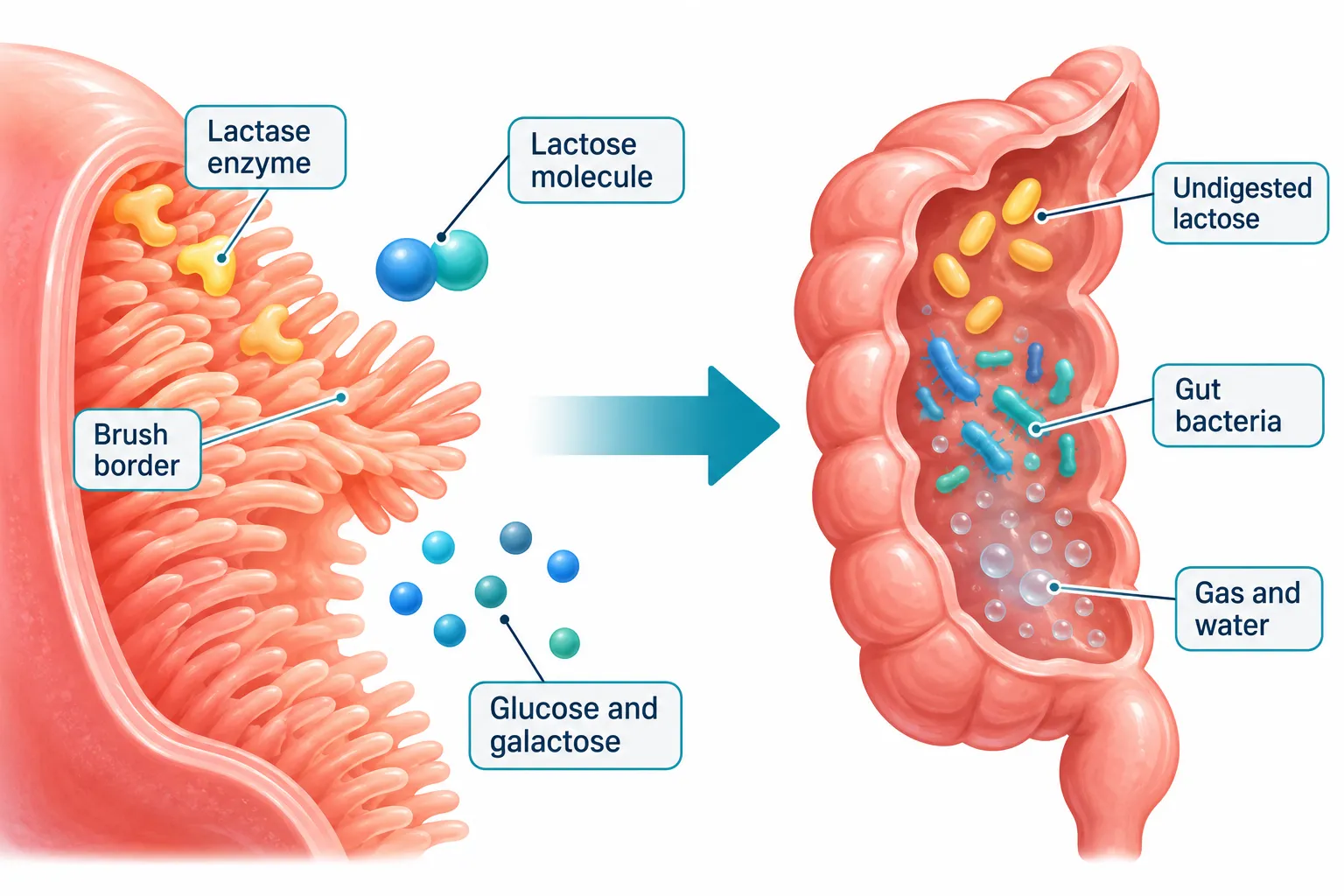
There are a few routes to low lactase:
- Lactase nonpersistence. This is the common one. Lactase activity is high in infancy and declines after weaning in most of the world’s adult population. It is normal human biology, not a disease.
- Secondary (acquired) low lactase. Damage or inflammation of the small intestinal lining, from illnesses such as celiac disease, gastroenteritis, or Crohn’s disease, can temporarily reduce lactase activity [4]. This type can improve if the underlying problem is treated.
- Congenital lactase deficiency. Very rare, present from birth.
A distinction worth holding onto: lactose malabsorption is not the same as lactose intolerance. Plenty of people malabsorb lactose and feel nothing. Intolerance means malabsorption plus symptoms. The 2026 Mexican gastroenterology guideline separates lactase nonpersistence, hypolactasia, clinical lactose intolerance, self-perceived intolerance, and lactose sensitivity for exactly this reason [1].
The stronger evidence points to a spectrum, not a switch. Where you sit on it determines how much, if anything, you need to change.
How do you know if you are lactose intolerant
You do not know from symptoms alone. Bloating, gas, cramping, and loose stools after dairy are suggestive, but they overlap heavily with irritable bowel syndrome, celiac disease, small intestinal bacterial overgrowth, and plain overeating. Confirming it takes a structured approach, usually with a clinician.
How assessment typically works:
- Symptom and food diary. Note what was eaten, how much, whether it was with a meal, and what happened over the next 30 minutes to several hours. Patterns matter more than single episodes.
- A short, supervised trial of lactose reduction. If symptoms clearly improve, that is informative, though not proof.
- Hydrogen breath testing. The standard objective test. You drink a measured lactose dose, and breath hydrogen is measured over a few hours. Rising hydrogen indicates colonic fermentation of unabsorbed lactose. Current guidance recommends standardized breath testing, supported where appropriate by genetic or biochemical testing [1].
- Ruling out other causes. Celiac serology and other tests are often sensible, particularly if symptoms are new, severe, or accompanied by weight loss.
Decision rule: choose self-management with mild, clearly dairy-linked, long-standing symptoms. Choose formal testing if symptoms are new in middle age, severe, worsening, or include anything on the red-flag list below.
A common mistake is self-diagnosing after one bad reaction to a creamy restaurant meal. Fat content, portion size, alcohol, and FODMAPs in the same dish all muddy the picture. For the overlap between dairy symptoms and general abdominal distension, our evidence-aware guide to bloating covers the wider set of causes.
Is there a difference between lactose intolerance and milk allergy
Yes, and the difference is clinically important. Lactose intolerance is a digestive issue caused by low lactase. Cow’s milk allergy is an immune reaction to milk proteins such as casein or whey, and it can cause hives, swelling, wheezing, vomiting, and in rare cases anaphylaxis.
Edge case: someone with milk allergy must avoid lactose-free dairy too, because the proteins remain. If reactions involve the skin, breathing, or throat, that is an allergy question for a physician, not a lactose question.
Who is most likely to get lactose intolerance, and can it start suddenly
Lactase nonpersistence is most common in adults of East Asian, West African, Arab, Jewish, Greek, Italian, and Native American ancestry, and least common in people of Northern European descent [4]. It is the global majority pattern, not an oddity.
Can it start suddenly? Not really, in the genetic sense, but it can feel sudden.
- Gradual decline, noticed abruptly. Lactase activity falls slowly over years. Many people only notice when intake increases or when their tolerance crosses a threshold.
- Secondary causes. A bout of gastroenteritis, a course of illness, or an untreated gut condition can temporarily reduce lactase and produce genuinely sudden symptoms [4]. This often improves as the lining recovers.
- Changes in habit. Retirement, travel, a new coffee routine with more milk, or a protein-shake habit can all shift daily lactose load.
A new pattern of digestive symptoms appearing for the first time after about age 50 deserves a medical review rather than a self-managed diet experiment. It usually turns out to be benign, but new-onset bowel change in older adults is one of those situations where checking is the sensible default.
What can I eat if I am lactose intolerant
Most people can keep eating dairy, just differently. The practical levers are portion size, timing with meals, fermentation, and aging. Hard aged cheeses and yogurt with live cultures are generally far better tolerated than a tall glass of milk on an empty stomach [2][3][8].
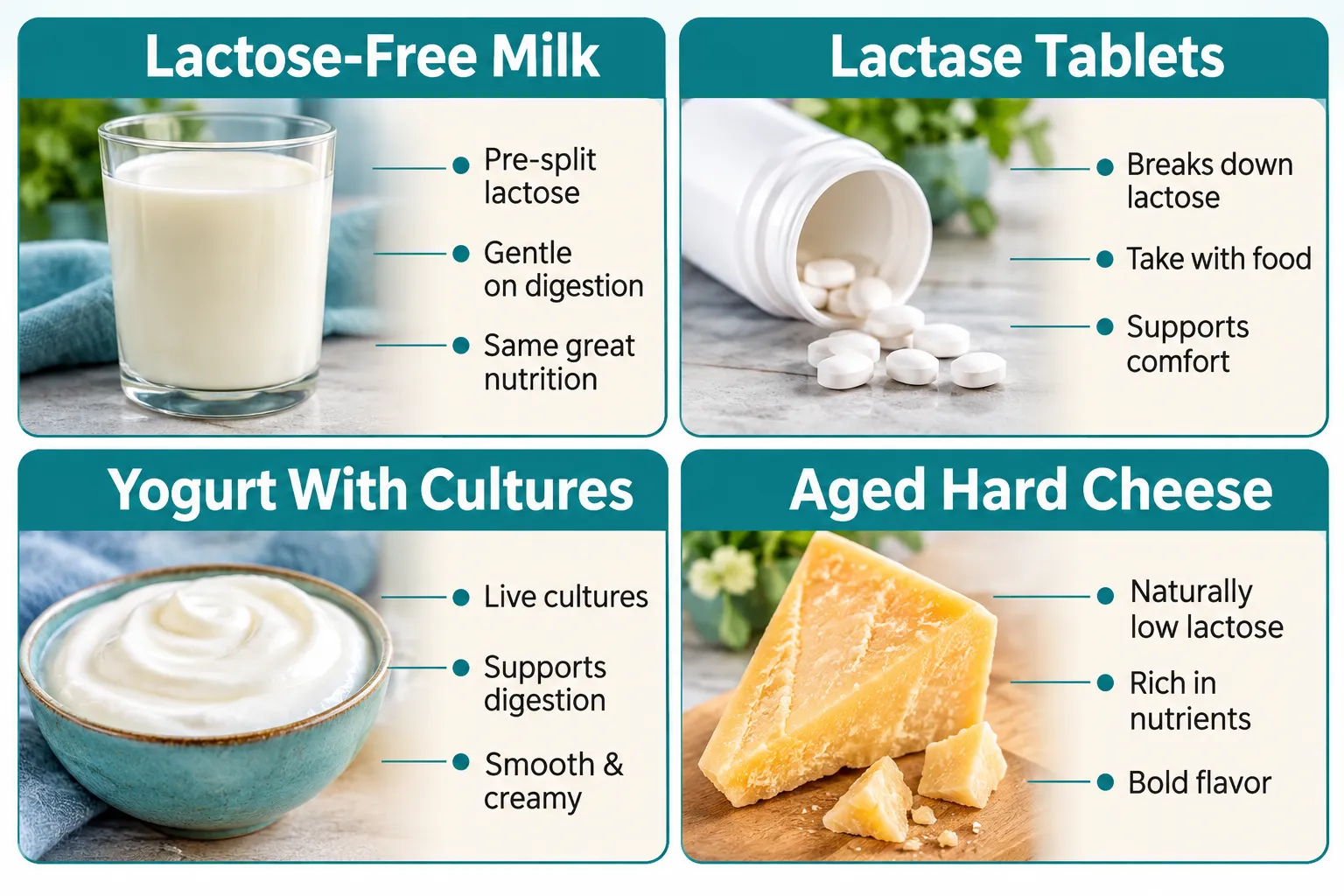
Generally well tolerated by many people:
- Aged hard cheeses (cheddar, parmesan, Swiss, gouda), lactose is largely lost during aging
- Plain yogurt and kefir with live cultures, bacterial cultures hydrolyze some lactose, and the thicker matrix slows transit [6][8]
- Butter, which is mostly fat
- Lactose-free milk, yogurt, and ice cream
- Small amounts of milk taken with a larger meal
More likely to cause symptoms:
- Milk on its own, especially a large glass
- Fresh soft cheeses such as ricotta and cottage cheese
- Cream-based sauces and soups in restaurant portions
- Ice cream and milkshakes
- Milk-based protein powders and meal-replacement drinks
There is no single gram threshold that applies to everyone, and anyone who gives you one is overstating what the evidence supports. Tolerance varies with gut transit, colonic bacteria, meal composition, and the individual. A sensible starting point is to reduce rather than remove, then rebuild upward one change at a time. For the broader context of how diet shapes digestive comfort, see our Gut Health and Digestive Wellness guide.
Lactase pills vs lactose-free milk: what actually works better
Neither is universally better. Lactose-free milk delivers more predictable results for routine, daily dairy, because the lactose has already been split during production. Lactase tablets or drops are more flexible for occasional, unplanned, or restaurant meals where you cannot control the ingredients [4][5].
How they differ in real-world terms:
- Lactose-free dairy is a product change. The manufacturer adds lactase during processing, so the sugar is already broken down before you drink it. Consistency is its main advantage.
- Lactase supplements are an on-demand enzyme taken with the food. Effectiveness depends on timing, the amount of lactose in the meal, stomach acidity, and the specific enzyme preparation. Some people get clear relief; others notice little. Research into more acid-stable fungal beta-galactosidases, including enzymes from Aspergillus carbonarius, suggests current commercial preparations vary in how well they survive the stomach [4].
What about “lactase pills vs lactase supplements”? They are the same category. “Lactase supplement” is the umbrella term; the formats are tablets, chewables, caplets, and liquid drops you add to milk before refrigerating. Drops act on the milk in advance; tablets act in the stomach and small intestine. Choose drops if you want control over your own milk, tablets if you eat out.
Decision rule:
- Daily milk, coffee, or cereal habit → lactose-free dairy
- Dining out, travel, holiday meals, unpredictable menus → lactase tablets
- Occasional yogurt or cheese only → often neither is needed
How much do lactose intolerance medications cost
There are no prescription medications for lactose intolerance in routine use, so there is no co-pay question in the usual sense. The relevant costs are over-the-counter lactase products and lactose-free dairy, both of which are sold at ordinary grocery and pharmacy prices without insurance involvement. Store-brand lactase tablets are typically cheaper than name brands with comparable enzyme activity, and lactose-free milk generally costs modestly more than standard milk. Prices vary by region and retailer, so check locally rather than relying on a figure in an article.
Best over-the-counter options for lactose intolerance
The useful over-the-counter category is narrow: lactase enzyme products (tablets, chewables, drops) and lactose-reduced or lactose-free dairy foods. That is essentially the whole evidence-supported OTC toolkit [4][5]. Anti-gas products containing simethicone may ease the sensation of bloating for some people but do nothing to the underlying lactose. Before adding any supplement, a pharmacist can check for interactions with your existing medicines. Do not change prescribed medications on your own.
Do probiotics actually help with lactose intolerance
Some people benefit, but the effect is strain-specific and not guaranteed. Studies have reported improvements with strains including Lactobacillus acidophilus DDS-1 and Bifidobacterium animalis BB-12 or Bi-07, and with some multi-strain formulations, though results vary by strain, dose, product matrix, and population [6].
What matters most here is this: “probiotic” is not a single intervention. Buying an unspecified blend and hoping is not the same as using a strain studied for lactose digestion.
Practical reading of the evidence:
- Fermented dairy has the most consistent practical support. Yogurt cultures hydrolyze some lactose, and the semi-solid food matrix slows transit, giving enzymes more contact time [2][6][8].
- Standalone probiotic capsules are more variable. Promising, but the trials differ enough that confident blanket recommendations are not justified.
- Give any trial a fair run. If a specific product makes no difference over several weeks of consistent use, it is reasonable to stop.
Emerging work described in a 2026 clinical review points toward synbiotics, engineered probiotics, precision nutrition, and microbiome-based approaches as future directions [2]. Interesting, but still future directions. We need to separate fact from hype: none of that is available or validated as standard care today.
Can lactose intolerance be cured, and can you build tolerance again
There is no cure for lactase nonpersistence. No approved therapy restores lactase production permanently, and current management remains dietary adjustment, lactase supplementation, lactose-hydrolyzed dairy, and selected probiotic or fermented-dairy strategies [1][4].
Two honest nuances:
- Secondary lactose intolerance can improve. If low lactase followed gut injury or inflammation, treating the underlying condition may restore tolerance over time [4]. That is recovery from the cause, not a cure for the genetic pattern.
- Tolerance can often improve, within limits. Many people find that gradually reintroducing small, regular amounts of lactose with meals becomes more comfortable over weeks. The likely explanation is colonic adaptation: the gut bacteria shift toward handling lactose with less gas production. This does not increase lactase in the small intestine, and the effect fades if regular intake stops.
So, can you build tolerance to lactose again? Partly, sometimes, and modestly. There is no magic in it. The approach is slow, consistent, small amounts with food, backed off if symptoms return. People with ongoing gut inflammation or other diagnosed digestive conditions should discuss any reintroduction plan with their clinician first.
Nutrition: calcium, vitamin D, and protein without the guesswork
Avoiding dairy without replacing what it provided is the most common unforced error in lactose intolerance treatment. Dairy contributes a large share of calcium, vitamin D (where fortified), protein, iodine, and vitamin B12 in typical US diets, and long-term unnecessary avoidance raises the risk of shortfalls [2][5][7]. For adults in their 50s and 60s, when bone density and muscle mass are already under pressure, that matters.

Is lactose-free milk just as healthy as regular milk? Nutritionally, yes, in the ways that count. Lactose-free milk is ordinary milk with lactase added to split the lactose into glucose and galactose. Protein, calcium, and added vitamin D are unchanged. It tastes slightly sweeter because those simple sugars register as sweeter on the tongue, but total sugar content is not higher. Check the label if you are watching added sugars, since flavored versions differ.
If you reduce dairy, cover these bases:
- Calcium: canned sardines and salmon with bones, firm tofu set with calcium, fortified plant milks (shake the carton, calcium settles), almonds, kale, bok choy, white beans.
- Vitamin D: oily fish, egg yolks, fortified foods. Sunlight exposure is unreliable in northern US winters. Blood testing and supplementation decisions belong with your clinician.
- Protein: eggs, fish, poultry, legumes, lactose-free dairy, hard cheese.
- B12 and iodine: worth checking if dairy intake drops substantially, particularly for those also limiting meat.
Plant milk caution: many plant milks are not nutritionally equivalent to cow’s milk. Almond and rice milks are typically low in protein. Soy milk is the closest protein match. Choose fortified versions and read the panel.
If several food groups are now off the table, a registered dietitian is the right call. One consultation often prevents a year of unnecessary restriction.
How to read labels without becoming obsessive
Lactose is not always listed by name. Scan for dairy-derived ingredients, and remember that trace amounts in processed foods rarely trouble people with ordinary lactose intolerance.
Ingredient terms that indicate lactose may be present:
- Milk, milk solids, nonfat dry milk, milk powder
- Whey, whey protein concentrate, whey solids
- Curds, buttermilk, milk sugar, lactose
- Cream, condensed or evaporated milk
Terms that usually do not mean lactose:
- Lactic acid, lactate, lactalbumin, casein, caseinate (casein is a protein, relevant to allergy, not to lactose)
- Cocoa butter, cream of tartar
A practical point: medications and supplements sometimes use lactose as a filler. The amounts are usually small, but if you are unusually sensitive, your pharmacist can tell you whether a specific product contains it. Do not stop or switch a prescribed medicine on that basis without speaking to the prescriber.
When symptoms need professional review
Lactose intolerance should be a nuisance, not an illness. Certain features do not fit the pattern and should prompt a medical appointment rather than another dietary experiment.
Seek medical assessment if you have any of the following:
- Blood in the stool or black, tarry stools
- Unintentional weight loss
- Persistent vomiting or fever
- Symptoms severe enough to disrupt daily life
- Diarrhea or pain that wakes you from sleep
- A new pattern of bowel change starting after about age 50
- Anemia, or fatigue without a clear explanation
- Symptoms that continue despite genuine lactose reduction
- Concern that your diet is no longer nutritionally adequate
- A family history of celiac disease, inflammatory bowel disease, or colorectal cancer
Who to see for what:
- Primary care clinician: first stop for assessment, testing, and referral.
- Gastroenterologist: breath testing, endoscopy, and evaluation of alternative or overlapping diagnoses.
- Registered dietitian: structured reintroduction plans and nutrient adequacy, especially calcium and vitamin D.
- Pharmacist: questions about lactase products, OTC choices, and lactose fillers in medicines.
Dairy symptoms are common. Dairy symptoms plus bleeding, weight loss, or night waking are a different conversation entirely.
Common mistakes and troubleshooting
Mistake 1: eliminating all dairy immediately. It feels decisive and often works short-term, but it removes the information you need and costs nutrition. Current guidance favors individualized reduction over a universal dairy-free diet [1][2].
Mistake 2: assuming every symptom is lactose. If you cut lactose properly for two to four weeks and nothing improves, lactose is probably not the main driver. Look at other FODMAPs, caffeine, alcohol, portion sizes, and stress, and get reassessed.
Mistake 3: testing tolerance with the hardest food available. A milkshake on an empty stomach is a poor test. Start with yogurt or hard cheese with a meal.
Mistake 4: expecting lactase tablets to handle any amount. They assist digestion; they do not create unlimited capacity. A very high-lactose meal may still cause symptoms.
Mistake 5: swapping to an unfortified plant milk and assuming it is equivalent. Check protein and calcium on the label.
Troubleshooting checklist:
- Keep a two-week food and symptom diary with portions and timing.
- Reduce, do not eliminate. Switch milk to lactose-free first; leave cheese and yogurt alone.
- Reassess after two weeks. Better, unchanged, or worse?
- If better, reintroduce one dairy food at a time, with meals, and note your personal ceiling.
- If unchanged, stop restricting and arrange a clinical review.
- Any red flag at any stage overrides the whole process. Book the appointment.
Frequently asked questions
Can lactose intolerance be cured permanently?
No. There is no approved therapy that permanently restores lactase production. Management is dietary adjustment, lactase enzyme products, lactose-hydrolyzed dairy, and in some cases fermented dairy or specific probiotic strains [1][4]. Secondary lactose intolerance caused by gut injury may improve if the underlying condition is treated.
Are lactase pills and lactase supplements different things?
No, they are the same category. “Lactase supplement” covers tablets, chewables, and liquid drops. Tablets and chewables are taken with lactose-containing food; drops are added to milk in advance. Effectiveness varies between products and between individuals.
Is lactose-free milk just as healthy as regular milk?
Yes, in nutritional terms. It is regular milk with lactase added, so protein, calcium, and fortified vitamin D are unchanged. It tastes slightly sweeter because lactose has been split into glucose and galactose, but the total sugar content is not increased.
Can you suddenly develop lactose intolerance as an adult?
Lactase decline is usually gradual, though it can be noticed abruptly. New symptoms can follow a gut infection or another condition affecting the small-intestine lining [4]. New digestive symptoms starting after about age 50 should be reviewed by a clinician rather than self-managed.
Do I need to avoid cheese and yogurt?
Usually not. Aged hard cheeses contain very little lactose, and yogurt with live cultures is generally better tolerated because the cultures hydrolyze some lactose and the thick matrix slows transit [8]. Fresh soft cheeses contain more lactose and are more likely to cause symptoms.
How is lactose intolerance diagnosed?
Most commonly with a hydrogen breath test after a measured lactose dose, supported where appropriate by genetic or biochemical testing and by excluding other causes such as celiac disease [1]. Symptoms alone are not sufficient, because several common conditions produce an identical picture.
Do probiotics help with lactose intolerance?
Some strains may help some people. Benefits have been reported for strains such as Lactobacillus acidophilus DDS-1 and Bifidobacterium animalis BB-12 or Bi-07, but results vary by strain, dose, and product [6]. Fermented dairy such as yogurt has more consistent practical support than generic probiotic capsules.
Conclusion
Lactose intolerance treatment is less dramatic than the internet suggests. The basics still do the heavy lifting: reduce rather than remove, eat dairy with meals, favor fermented and aged options, use lactose-free products where you want predictability, and try lactase tablets for the meals you cannot control. Protect calcium, vitamin D, and protein while you do it, because the long-term cost of unnecessary restriction is real.
Your next steps:
- Start a two-week food and symptom diary, recording portion, timing, and whether dairy was eaten with a meal.
- Make one change first, usually switching to lactose-free milk, and keep everything else constant.
- Reintroduce yogurt and aged cheese deliberately to find your personal tolerance.
- Review your calcium and vitamin D sources if dairy intake has dropped.
- Book a clinical appointment for any red flag, for new symptoms after age 50, or if restriction has not helped within a month.
Truth over hype: this is a manageable, dose-dependent digestive condition for most people, and the goal is a diet you can live with comfortably, not a shorter list of foods.
References
- Remes-Troche JM, et al. Clinical guideline of the Asociación Mexicana de Gastroenterología for the diagnosis and treatment of lactose ingestion-related disorders. 2026.
- Goyal M, Sandhu NK. Lactase Deficiency in 2026: Understanding Pathophysiology, Global Persistence Trends, and Targeted Therapies for Lactose Intolerance. Journal of the American Nutrition Association. 2026.
- Borralho AI, et al. Lactose Intolerance and Malabsorption Revisited: Exploring the Impact and Solutions. GE Portuguese Journal of Gastroenterology. 2025.
- Goosenberg E, Afzal M. Lactose Intolerance. StatPearls. Updated 2025.
- Wilt TJ, Shaukat A, Shamliyan T, et al. Lactose Intolerance and Health. Agency for Healthcare Research and Quality. 2010. Historical evidence review.
- Lactose intolerance and probiotics: from pathophysiological mechanisms to clinical applications. Antonie van Leeuwenhoek. 2026.
- Facioni MS, Raspini B, Pivari F, Dogliotti E, Cena H. Nutritional management of lactose intolerance: the importance of diet and food labelling. Journal of Translational Medicine. 2020.
- Ibrahim SA, et al. Fermented foods and probiotics: An approach to lactose intolerance. Journal of Dairy Research. 2021.
Medical disclaimer: This article is for general information and is not a substitute for personal medical advice. Speak with your clinician, pharmacist, or a registered dietitian about your own situation.

About the author
Dave James is the founder of All Perfect Health. He writes practical, evidence-aware health guides designed to separate what is established, what is promising and what is simply marketing.
📂 Health and Wellness → Gut Health & Digestive Wellness
Cluster guide: Gut Health and Digestive Wellness: Your Complete Guide
YOU ARE HERE Lactose Intolerance: Food Strategies, Lactase, and When Symptoms Need Review
Related reading: Bloating: What Causes It and How to Fix It