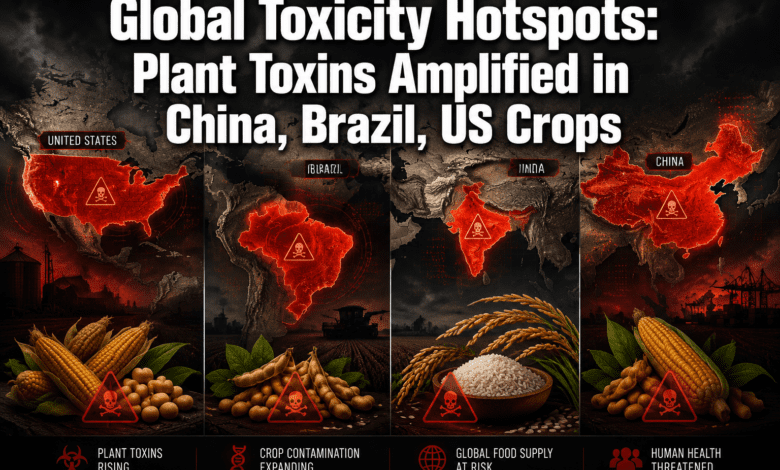
Global Toxicity Hotspots: Plant Toxins Amplified in China, Brazil, US Crops
Last updated: May 16, 2026
Quick Answer
Four countries — China, Brazil, the United States, and India — together account for 53–68% of global pesticide toxicity, according to a landmark study published in Science in February 2026. The crops driving this burden are ones most people eat every day: soybeans, corn, rice, fruits, and vegetables. Understanding where this toxicity is concentrated, and what it means for the food on your plate, is the starting point for making smarter choices.
Key Takeaways
- 🌍 Four nations, more than half the problem: China, Brazil, the US, and India collectively generate 53–68% of global total applied toxicity (TAT), based on data from 2013–2019 [7]
- 🌱 The crops that matter most: Fruits and vegetables, maize, soybeans, rice, and cereals account for 76–83% of global pesticide toxicity [3]
- 📈 Toxicity is rising, not falling: Even where total pesticide volume has stabilized, ecological toxicity is increasing because newer pesticides are more potent per unit [1]
- 🇧🇷 Brazil stands out: Brazil has among the highest pesticide toxicity per unit of agricultural area in the world, driven by soy, corn, and cotton monocultures [2]
- 🧪 Plant toxins and pesticide residues combine: Natural antinutrients in crops (lectins, phytates, oxalates) and synthetic pesticide residues can both affect digestion, absorption, and inflammation
- 🎯 The 2030 target is at risk: The COP15 goal to halve pesticide risk by 2030 is being undermined by current agricultural trends [6]
- 🛒 This reaches your kitchen: Imported soy, corn, and rice from hotspot countries carry both natural plant defense compounds and potential residue loads
- ✅ Practical steps exist: Soaking, fermenting, cooking, and choosing verified sources can meaningfully reduce both antinutrient and residue exposure
In this guide
- What Are Global Toxicity Hotspots and Why Do They Matter?
- Which Countries Are the Biggest Contributors to Global Pesticide Toxicity?
- How Do Plant Toxins in Soy, Corn, and Rice Add to the Burden?
- Why Is Toxicity Rising Even When Pesticide Use Appears Stable?
- What Does This Mean for Food Imported Into Your Kitchen?
- Are Organic and Certified Crops a Reliable Solution?
- What Can Individuals Do About Global Toxicity Hotspots in Their Food?
- FAQ: Global Toxicity Hotspots and Plant Toxins in Crops
- Conclusion: What Actually Matters Here
What Are Global Toxicity Hotspots and Why Do They Matter?
Global toxicity hotspots are geographic regions where pesticide use — weighted by the ecological harm of each chemical — is concentrated at levels that pose measurable risk to organisms across multiple groups, from soil invertebrates to pollinators to aquatic life.
The concept of Global Toxicity Hotspots: Plant Toxins Amplified in China, Brazil, US Crops goes beyond simple pesticide volume. What matters is not just how much is applied, but how harmful each compound is.
A 2026 study published in Science introduced a metric called Total Applied Toxicity (TAT) to address exactly this gap [7]. TAT weights pesticide use by ecological toxicity across eight organism groups, covering 625 active ingredients and country-level data from 2013 to 2019. The result is a clearer picture of where the real burden sits.
Here’s the real issue: a country can reduce the tonnes of pesticide it applies while simultaneously increasing ecological toxicity, simply by switching to more potent compounds. That is precisely what the data shows is happening globally [1].
The TAT framework in plain English
| Metric | What it measures |
|---|---|
| Pesticide volume (kg) | Raw quantity applied — familiar but incomplete |
| Total Applied Toxicity (TAT) | Volume × toxicity per organism group — a more honest measure of harm |
| TAT per hectare | Intensity of toxicity on a given area of farmland |
The TAT approach makes it possible to compare countries and crops on a level playing field. And the results are striking.
Which Countries Are the Biggest Contributors to Global Pesticide Toxicity?
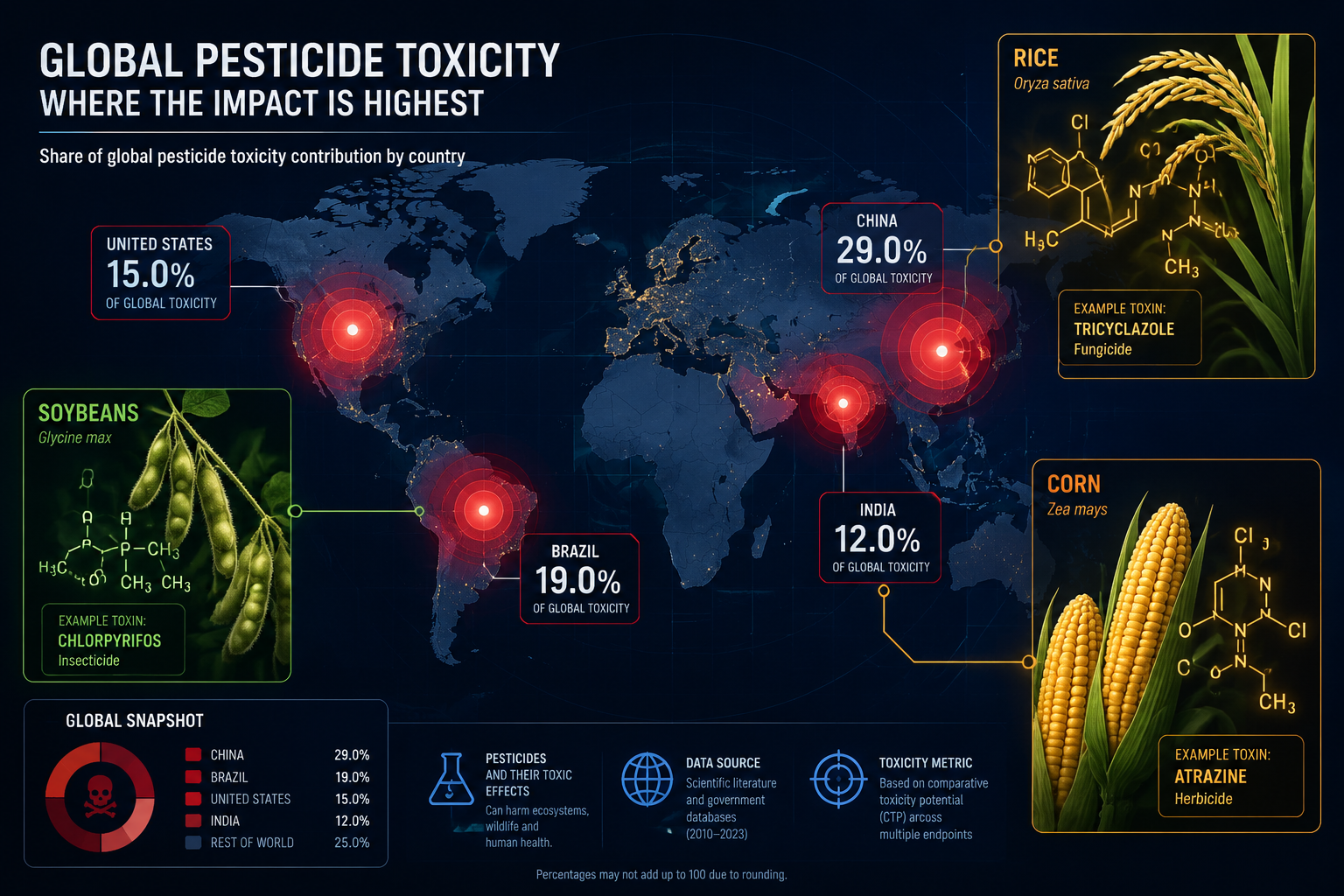
China, Brazil, the United States, and India are the four dominant contributors to global pesticide toxicity, accounting for 53–68% of global TAT. Brazil and China are particularly notable for high toxicity per unit of agricultural area [4].
Let’s keep this practical. These are not obscure agricultural nations. They are the world’s largest food exporters. What happens on their farms reaches supermarket shelves in every country.
Country-by-country breakdown
🇨🇳 China
- Largest single contributor to global TAT in absolute terms
- Intensive rice, vegetable, and fruit production drives high per-hectare toxicity
- Heavy use of insecticides, particularly those with high aquatic invertebrate toxicity [6]
🇧🇷 Brazil
- Among the highest pesticide toxicity per unit agricultural area globally [2]
- Large-scale soy, corn, and cotton monocultures are the primary driver
- Rapid expansion of agricultural land into the Cerrado and Amazon regions compounds the problem [5]
🇺🇸 United States
- Third major contributor, driven by corn and soy belt agriculture
- Herbicide use (particularly glyphosate-based products) is extensive, though herbicide TAT differs by organism group from insecticide TAT [3]
- Fruit and vegetable production in California adds a high-intensity layer
🇮🇳 India
- Fourth major hotspot, with rice, cotton, and vegetable production as key drivers
- Regulatory gaps mean older, more acutely toxic compounds remain in use longer [6]
“The evidence suggests that global pesticide toxicity is rising and is actively undermining the COP15 goal to halve pesticide risk by 2030.” — Summary of findings from the 2026 Science study [7]
How Do Plant Toxins in Soy, Corn, and Rice Add to the Burden?
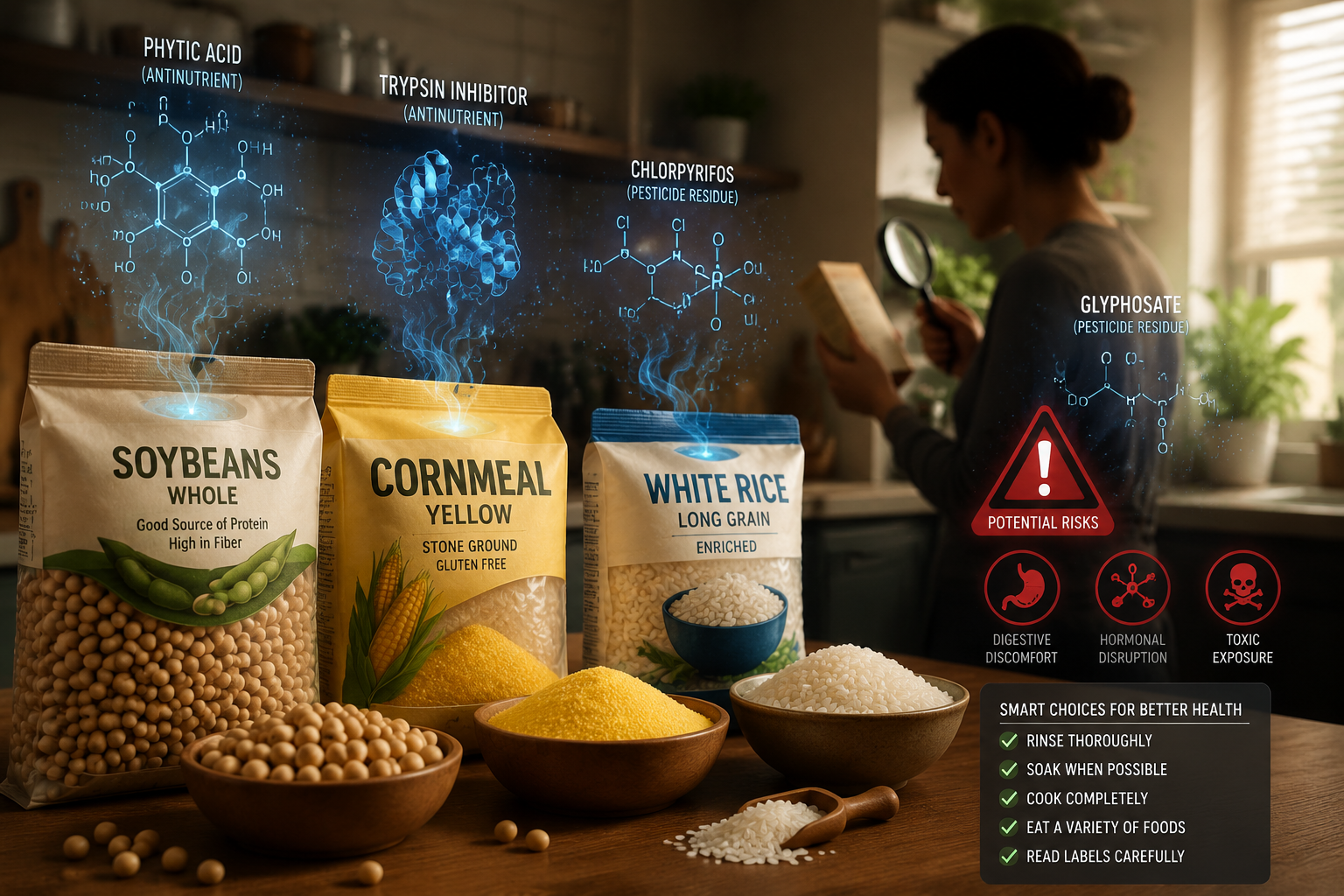
Beyond synthetic pesticide residues, the crops most associated with global toxicity hotspots — soybeans, corn, and rice — also contain natural plant defense compounds (antinutrients) that can affect digestion and nutrient absorption.
This is where the picture gets more layered. When people talk about toxins in food crops, they usually mean one or the other — pesticide residues or natural plant compounds. In reality, both are present in the same foods, and both are worth understanding.
For a deeper look at how these natural compounds work, see what plant toxins actually do to your body.
Key antinutrients in hotspot crops
Soybeans (major crop in Brazil, US, China)
- Phytates (phytic acid): Bind zinc, iron, and calcium, reducing absorption
- Lectins: Can irritate gut lining at high doses; mostly deactivated by cooking
- Protease inhibitors: Interfere with protein digestion; heat-sensitive
- Isoflavones: Phytoestrogens with dose-dependent hormonal effects
Corn/Maize (major crop in US, Brazil, China)
- Phytates: Present in the bran; reduce mineral availability
- Zein (a prolamin protein): Poorly digestible; may contribute to gut irritation in sensitive individuals
- Aflatoxins: Fungal toxins (not plant-produced, but crop-associated) that concentrate in improperly stored corn — a genuine food safety concern in tropical growing regions
Rice (major crop in China, India)
- Phytates: Present in brown rice; largely removed by milling in white rice
- Arsenic: Not a plant toxin per se, but rice bioaccumulates inorganic arsenic from soil and water — particularly relevant in Asian growing regions
- Lectins: Present in rice bran at lower levels than legumes
It is not that simple to say these compounds are uniformly harmful. Context matters. Dose, preparation method, and individual gut health all change the outcome significantly. For background on why traditional food preparation methods addressed these compounds, see why our ancestors cooked plant foods.
Why Is Toxicity Rising Even When Pesticide Use Appears Stable?
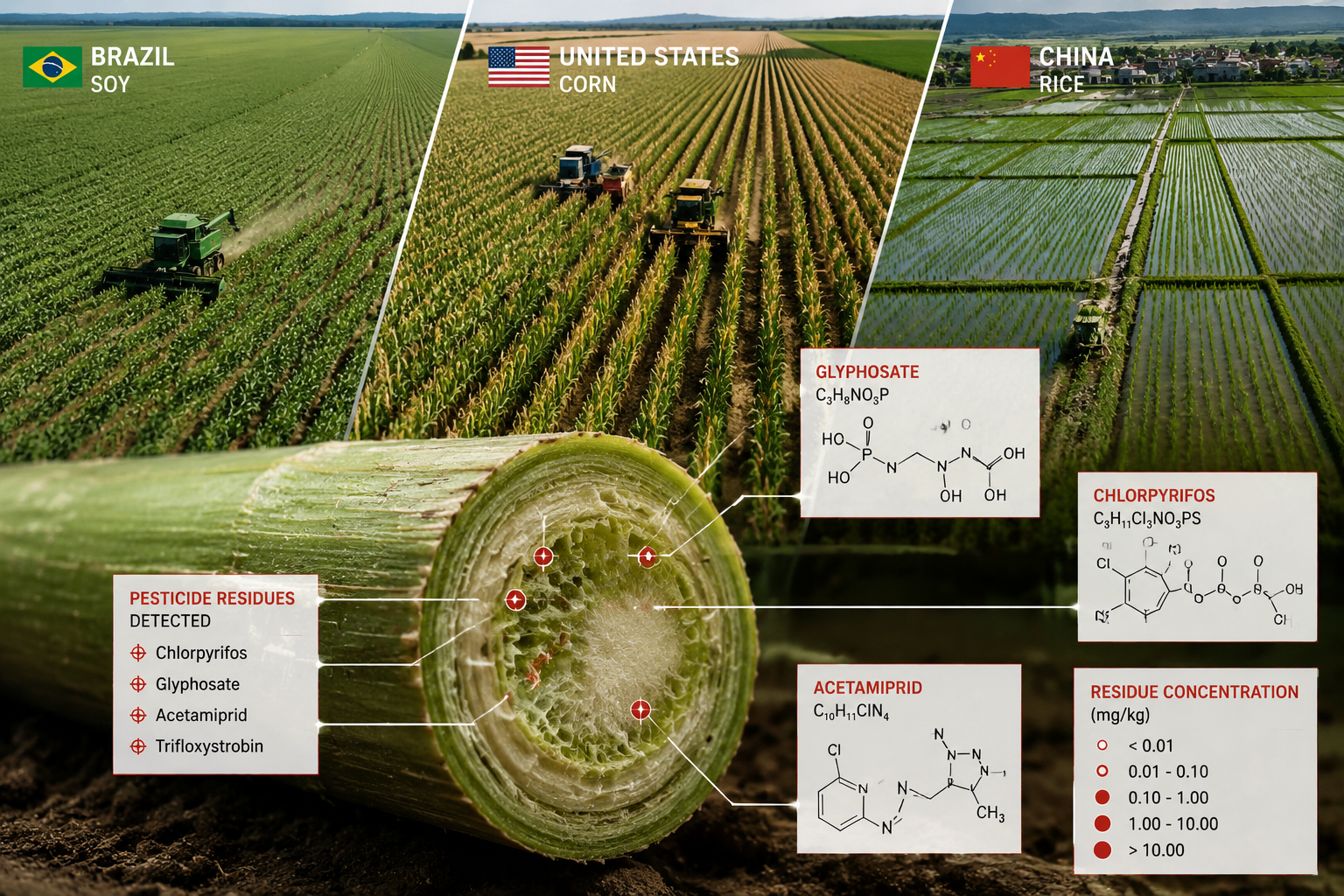
Global pesticide toxicity is increasing because the industry has shifted toward compounds that are more potent per kilogram applied, meaning total volume figures understate the real ecological burden.
This is where hype gets in the way of understanding. Headlines about “falling pesticide use” in certain countries can be technically accurate while missing the point entirely. The Science study found that TAT is rising even in regions where raw pesticide tonnage has plateaued or declined [1].
The potency shift
The clearest example involves neonicotinoid insecticides. These compounds are applied in smaller quantities than older organophosphates, so they look better on volume-based metrics. But they are orders of magnitude more toxic to pollinators and aquatic invertebrates per unit applied [6].
The same pattern applies to some newer herbicides and fungicides. Less volume, same or greater ecological harm.
What matters most is this: the metric used to measure pesticide safety determines what story the data tells. TAT is a more honest measure, and it tells a more concerning story [7].
The crop intensification factor
Even where pesticide formulations have not changed, expanding monocultures in Brazil, China, and the US mean more total area treated, more applications per season, and higher TAT in absolute terms [2].
Fruits and vegetables alone account for a disproportionate share of global TAT — not because they use the most pesticide by weight, but because the compounds used in high-value horticulture tend to be more acutely toxic [3].
What Does This Mean for Food Imported Into Your Kitchen?
If you regularly eat soy products, corn-based foods, or rice, there is a meaningful chance those crops originated in one of the four global toxicity hotspots — China, Brazil, the US, or India — and carry both natural antinutrient loads and potential pesticide residue profiles worth understanding.
In real-world terms, this does not mean these foods are dangerous to eat. It means the source and preparation of those foods matters more than most people assume.
Tracing the supply chain
Most people do not know where their soy, corn, or rice comes from. Here is a practical guide to what is likely:
| Food product | Likely origin | Key concern |
|---|---|---|
| Soy milk / tofu | US, Brazil, China | Phytates, lectins, pesticide residues |
| Corn tortillas / cornmeal | US, Brazil | Phytates, potential mycotoxins |
| White rice | China, India, Thailand | Inorganic arsenic (especially in brown rice) |
| Soy protein isolate | US, Brazil | Concentrated phytates; processing removes some lectins |
| Edamame | China | Lectins, phytates; cooking largely neutralises both |
The environmental factors that affect human health extend well beyond what most people consider when choosing food. Agricultural origin is one of them.
Practical risk reduction
A sensible starting point is addressing preparation before worrying about sourcing. Most natural plant toxins in these crops are significantly reduced by standard cooking methods:
- Soaking dried legumes (soybeans, lentils) for 8–12 hours and discarding the water reduces phytates by 30–70% [10]
- Boiling destroys most lectins and protease inhibitors in soy and corn
- Fermentation (as in miso, tempeh, natto) is the most effective method for reducing phytates and lectins in soy
- Rinsing rice before cooking and using a high water-to-rice ratio reduces arsenic content meaningfully
- Cooking brown rice in excess water (6:1 ratio) and draining can reduce inorganic arsenic by up to 40–60% compared to absorption cooking [10]
For more on how gut health interacts with these compounds, the gut health and digestive wellness guide covers the mechanisms clearly.
Are Organic and Certified Crops a Reliable Solution?
Organic certification reduces synthetic pesticide exposure meaningfully, but it does not eliminate plant antinutrients, and it does not guarantee lower toxicity in all ecological categories.
That is a strong claim and needs strong proof, so let’s be precise about what the evidence actually shows.
Organic farming prohibits most synthetic pesticides. That directly reduces TAT contributions from the most acutely toxic synthetic compounds. For consumers, organic soy, corn, and rice will generally carry lower synthetic pesticide residue loads [9].
However:
- Natural antinutrients are unaffected by organic status. Phytates, lectins, and oxalates are produced by the plant regardless of how it was grown.
- Some permitted organic pesticides carry meaningful ecological toxicity. Copper-based fungicides, for example, accumulate in soil and are toxic to earthworms and aquatic invertebrates [9].
- Organic certification does not address arsenic in rice. Arsenic uptake is determined by soil and water chemistry, not farming method.
- Supply chain transparency remains limited. “Organic” on a label in a European or North American supermarket does not always mean the crop was grown under rigorous third-party verified conditions.
The stronger evidence points to a combined approach: organic where practical, plus proper preparation regardless of certification status.
What Can Individuals Do About Global Toxicity Hotspots in Their Food?
The most effective individual responses to Global Toxicity Hotspots: Plant Toxins Amplified in China, Brazil, US Crops are preparation-based rather than avoidance-based. Eliminating soy, corn, and rice from the diet is not necessary or practical for most people. Reducing the toxin load through preparation and sourcing choices is both feasible and evidence-supported.
A practical action checklist
✅ Soak dried legumes (including soybeans) before cooking — discard soaking water
✅ Choose fermented soy (miso, tempeh, natto) over raw or minimally processed soy protein
✅ Rinse rice before cooking; consider parboiled rice, which has lower arsenic than brown rice
✅ Diversify grains — rotating between rice, oats, quinoa, and barley reduces reliance on any single crop from a hotspot region
✅ Check country of origin on food labels where available — this information is legally required on many packaged foods in the US, EU, and UK
✅ Choose certified organic for high-residue crops (fruits, vegetables) where budget allows — the Environmental Working Group’s annual Dirty Dozen list is a useful reference
✅ Cook thoroughly — most heat-sensitive plant toxins (lectins, protease inhibitors) are neutralised at boiling temperatures
✅ Vary protein sources — rotating between legumes, eggs, fish, and meat reduces overexposure to any single antinutrient profile
Start with what gives the biggest return: soaking and cooking legumes properly costs nothing and removes a significant portion of the antinutrient load. That is more impactful than expensive supplements or elimination diets.
For readers managing digestive sensitivity, the bland diet guide for digestion offers a practical framework for reducing gut irritation during periods of adjustment.
The best anti-inflammatory foods for gut health also provides a useful counterpoint — many of the foods that reduce inflammation are naturally low in the antinutrients discussed here.
FAQ: Global Toxicity Hotspots and Plant Toxins in Crops
Q: What is “Total Applied Toxicity” (TAT) and why does it matter?
TAT is a metric that multiplies pesticide volume by the ecological toxicity of each compound across eight organism groups. It gives a more accurate picture of real-world harm than raw pesticide weight alone. A country can reduce volume while increasing TAT by switching to more potent chemicals [7].
Q: Is Brazil really worse than the US for pesticide toxicity?
Brazil has among the highest pesticide toxicity per unit of agricultural area globally, driven by large-scale soy, corn, and cotton monocultures. The US contributes more in absolute TAT terms due to sheer scale, but Brazil’s intensity per hectare is particularly high [2].
Q: Are lectins in soybeans dangerous?
In plain English: lectins in raw soybeans are problematic, but standard cooking destroys most of them. Properly cooked or fermented soy products pose minimal lectin risk for most people. The concern applies mainly to raw or undercooked legumes [10].
Q: Does washing rice reduce arsenic?
Yes. Rinsing rice before cooking and using excess water (then draining) can reduce inorganic arsenic content by 40–60% compared to absorption cooking. This is particularly relevant for people eating rice as a daily staple [10].
Q: Does organic certification eliminate pesticide residues?
Organic certification prohibits most synthetic pesticides, which meaningfully reduces residue risk. However, some permitted organic pesticides carry ecological toxicity, and organic status does not affect natural plant antinutrients or arsenic in rice [9].
Q: Which crops carry the highest global pesticide toxicity burden?
Fruits and vegetables, maize (corn), soybeans, rice, and cereals together account for 76–83% of global TAT. Fruits and vegetables are disproportionately high relative to their volume because the compounds used in horticulture tend to be more acutely toxic [3].
Q: Is the COP15 goal to halve pesticide risk by 2030 achievable?
Based on current trends, the evidence suggests it is not on track. Global TAT is rising, not falling, and the four major hotspot countries — China, Brazil, the US, and India — have not implemented policies sufficient to reverse this trajectory [6].
Q: Should I stop eating soy and corn because of this?
No. The evidence does not support elimination. It supports informed sourcing, proper preparation, and dietary variety. Both soy and corn are nutritious foods when properly prepared. The goal is reducing unnecessary exposure, not avoidance [1].
Q: How does phytic acid affect mineral absorption?
Phytic acid binds minerals like zinc, iron, and calcium in the gut, reducing how much the body absorbs. Soaking, sprouting, and fermenting legumes and grains significantly reduces phytate content. People eating varied diets with adequate mineral intake are generally not at significant risk [10].
Q: What is the most practical first step for reducing exposure?
Soak and properly cook legumes. Rinse rice before cooking. Diversify grains. These three steps cost nothing and address the most significant sources of antinutrient and residue exposure in everyday diets.
Conclusion: What Actually Matters Here
The 2026 Science study on global pesticide toxicity is significant research. It confirms what careful observers have suspected for years: the problem is not just how much pesticide is used, but how harmful the compounds are, and where the burden is concentrated.
The main takeaway is this: four countries — China, Brazil, the United States, and India — generate more than half of global pesticide toxicity. The crops at the centre of this are the ones most people eat regularly: soy, corn, rice, fruits, and vegetables. These same crops also carry natural plant defense compounds that, in sufficient quantities and without proper preparation, can affect digestion and nutrient absorption.
None of this means these foods are dangerous. It means preparation and sourcing decisions carry more weight than most people realise.
Keep it simple and consistent: soak legumes, cook thoroughly, rinse rice, vary your grains, and choose organic for high-residue produce when it is practical. These are not dramatic interventions. They are sensible habits that reduce exposure without requiring an overhaul of how you eat.
The bigger picture — rising global TAT, the COP15 target falling behind, and intensifying monocultures in the world’s largest agricultural nations — is a policy problem that individuals cannot solve alone. But understanding it clearly is the first step toward making food choices that are grounded in evidence rather than either panic or indifference.
I’d rather be accurate than impressive on this one. The basics still do the heavy lifting.
📂 Plant Toxins & Antinutrients
This article is part of the APH cluster. Use the links below to move between the pillar and child articles.
- Read the pillar: Plant Toxins, Antinutrients and Why Our Ancestors Cooked: The Complete Evidence-Based Guide
- → What Plant Toxins Actually Do to Your Body: Effects on Digestion, Absorption and Inflammation
- → Enzyme Inhibitors in Raw Plant Foods: Why Cooking Matters More Than Influencers Admit
- → How Traditional Food Preparation Reduces Antinutrients: Soaking, Sprouting, Fermenting and Cooking
- → Synergistic Plant Toxin Effects: How Oxalates Amplify Lectin Damage in the Gut
- → Histamine Intolerance and Plant Lectins: The Overlooked Gut-Brain Connection
- → Plant Toxins and Brain Fog: New 2026 Studies Linking Phytates to Cognitive Decline
- → Antinutrients and Skin Health: How Tannins and Phytoestrogens Trigger Eczema Flares
- → Kids and Plant Toxins: Antinutrient Impacts on Growth, ADHD, and Developing Brains
- → Pesticides vs Plant Toxins: Which Is the Bigger Threat to Your Health and the Environment?
- → Climate Change and Plant Toxins: Rising Levels of Alkaloids and Glycosides in Crops
- YOU ARE HERE Global Toxicity Hotspots: Plant Toxins Amplified in China, Brazil, US Crops
References
[1] Pesticides Have Become More Harmful Globally New Study Finds – https://sustainable-rdn.com/2026/03/10/pesticides-have-become-more-harmful-globally-new-study-finds/ [2] Rising Pesticide Toxicity Brazil Science Study Insights – https://www.academicjobs.com/br/research-publication-news/rising-pesticide-toxicity-brazil-science-study-insights-or-academicjobs-5973 [3] Global Pesticide Toxicity Is Rising And Threatening Biodiversity – https://daily27.info/2026/02/08/global-pesticide-toxicity-is-rising-and-threatening-biodiversity/ [4] EurekAlert – https://www.eurekalert.org/news-releases/1114835 [5] Pesticides Have Become More Harmful Globally Study Finds – https://agenciabrasil.ebc.com.br/en/meio-ambiente/noticia/2026-02/pesticides-have-become-more-harmful-globally-study-finds [6] Pesticide Toxicity Threatens Global Biodiversity – https://phys.org/news/2026-02-pesticide-toxicity-threatens-global-biodiversity.html [7] Science – https://www.science.org/doi/10.1126/science.aea8602 [9] MDPI Toxics – https://www.mdpi.com/2305-6304/14/5 [10] PMC11396851 – https://pmc.ncbi.nlm.nih.gov/articles/PMC11396851/Safety and nuance
Geographic toxicity risk is a food-quality and supply-chain issue, not a reason to panic about every imported crop. People with existing liver, kidney, neurological, pregnancy or child-health concerns should use this article as a discussion starter with a qualified clinician, not as a diagnosis or treatment plan.

Dave James has spent 30+ years reading health and longevity research, and has run All Perfect Health for the past five. His background is in Australian mining and industrial engineering — disciplines built on questioning claims, measuring outcomes, and respecting evidence. He writes about what the research actually says, including where the experts disagree.
More about Dave & this site →