Daily Habits of People Who Live Past 90: What the Research Shows
Last updated: May 5, 2026
Quick Answer: People who live past 90 do not share a single diet or exercise plan. What the research consistently shows is that daily habits around movement, social connection, purpose, emotional stability, and cognitive engagement matter far more than any specific food or fitness routine. The strongest evidence points to small, repeated behaviors done consistently over decades — not dramatic lifestyle overhauls.
Key Takeaways
- No universal diet or exercise pattern exists among people who reach 90+. Some are vegetarians; others eat meat daily. The variation is wide. [1]
- Consistent low-grade movement throughout the day appears more protective than sporadic intense workouts, according to vascular surgery research. [2]
- A sense of purpose and social usefulness is one of the strongest predictors of survival past 95, independent of physical health markers. [1]
- Emotional stability — managing reactions and avoiding chronic negativity — is associated with approximately three extra years of life, per the NIH’s Baltimore Longitudinal Study of Aging. [4]
- Moderate caffeine consumption (200+ mg/day) was linked to a 34% lower dementia risk in The 90+ Study. [6]
- Reading daily reduced dementia incidence by 26% in the oldest-old population studied. [6]
- Religious or spiritual engagement was associated with a 47% reduced dementia risk in the same study. [6]
- Being overweight in your 70s was counterintuitively linked to longer survival than being underweight or normal weight. [3]
- Social and leisure activities — including crafts, being with animals, and going to movies — all showed meaningful reductions in dementia risk. [6]
- The basics still do the heavy lifting: sleep, movement, connection, and purpose. There is no magic in it.
Table of Contents
- What Do People Who Live Past 90 Actually Have in Common?
- Why Consistent Daily Movement Matters More Than Intense Exercise
- What Role Does Diet Play in Living Past 90?
- How Social Connection and Purpose Affect Longevity
- What Cognitive Habits Protect the Brain in the Oldest-Old?
- Does Sleep Quality Matter for Extreme Longevity?
- Are There Personality Traits That Predict Living Past 90?
- Daily Habits of People Who Live Past 90: A Practical Summary
- FAQ: Daily Habits of People Who Live Past 90
- Conclusion: What Actually Moves the Needle
What Do People Who Live Past 90 Actually Have in Common?
The honest answer is: less than most people expect. Research into the daily habits of people who live past 90 consistently finds that diet and exercise routines vary enormously among the oldest-old. Some were lifelong vegetarians. Others ate red meat regularly. Some walked miles every day; others were never particularly athletic. [1]
This is where hype gets in the way. The popular narrative — eat this superfood, follow this exercise protocol, and you will reach 100 — does not hold up under scrutiny. The 90+ Study, run by the University of California Irvine’s MIND Institute and one of the largest investigations into extreme longevity ever conducted, found no single dietary pattern that predicted survival into the 90s. [3]
What researchers did find, repeatedly and across multiple independent studies, is a cluster of behavioral and psychological habits. These are not dramatic. They are not expensive. But they are consistent, and the evidence behind them is worth taking seriously.
“The basics still do the heavy lifting. There is no magic in it — just habits practiced quietly over a very long time.”
Why Consistent Daily Movement Matters More Than Intense Exercise
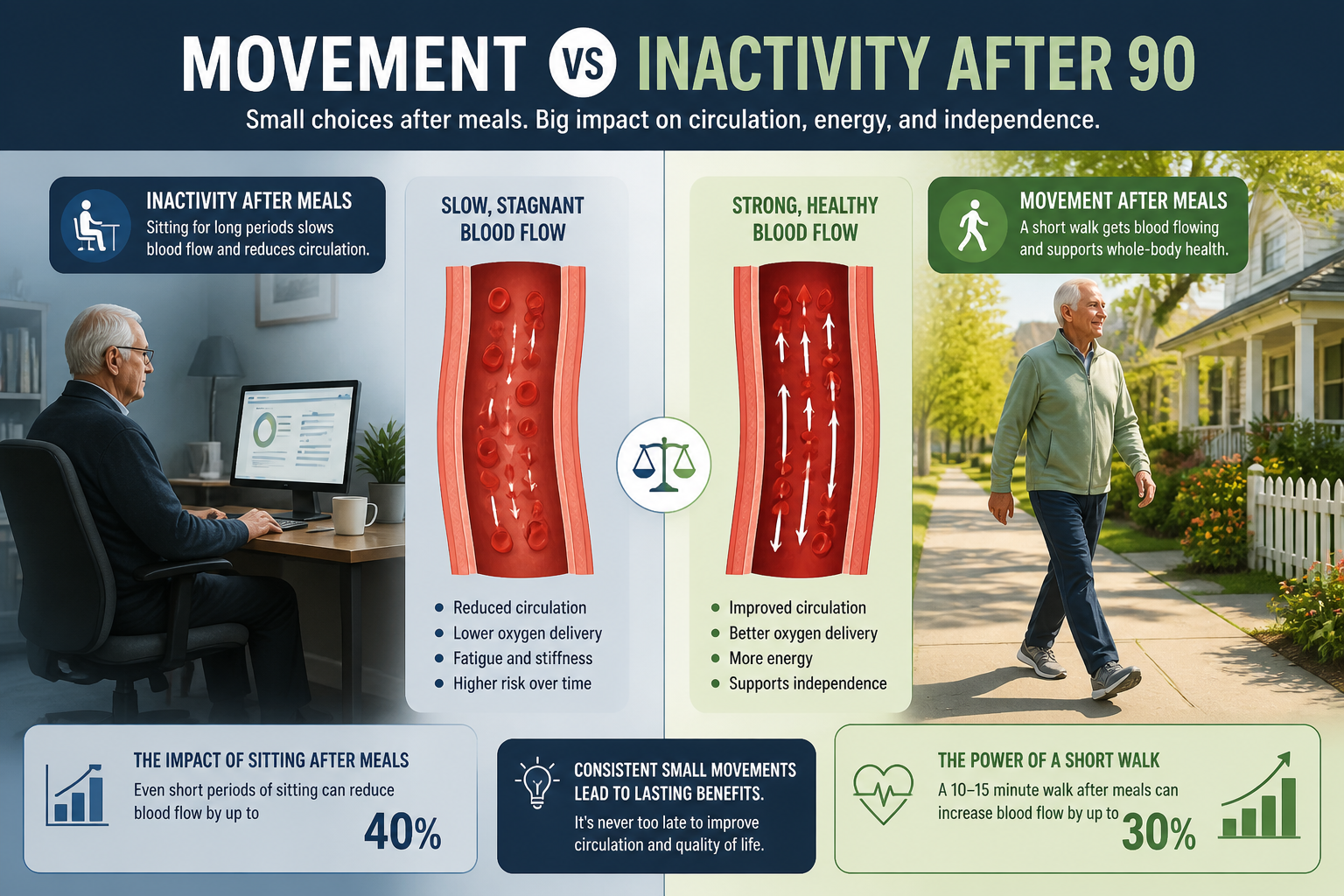
The stronger evidence points to movement frequency over movement intensity. Dr. Rema Malik, a vascular surgeon who has studied her longest-living patients, reported in March 2026 that the one habit she observed most consistently was this: they never let their blood “sit still.” [2]
In plain English, that means small, repeated movements throughout the day — not an hour at the gym three times a week. Standing after meals, short walks, light stretching, gardening, household tasks. The mechanism is straightforward: circulation. Blood that moves regularly delivers oxygen and nutrients more efficiently, reduces clotting risk, and supports cardiovascular function over decades.
The “post-meal flush” — simply moving for 10 to 15 minutes after eating — is one of the simplest, most repeatable habits described in this research. [2] It requires no equipment, no gym membership, and no special fitness level.
Practical breakdown of movement habits seen in 90+ year-olds:
| Habit | Frequency | Why it matters |
|---|---|---|
| Short post-meal walks | After each main meal | Supports circulation and blood sugar regulation |
| Light gardening or housework | Daily | Low-impact, purposeful movement |
| Standing and stretching | Every 30–60 minutes | Prevents prolonged sedentary periods |
| Social walking (with others) | Several times per week | Combines movement with connection |
For anyone over 50 looking to build this kind of foundation, our exercise guide for better health covers the practical starting points in detail. If you are specifically working around joint issues or returning to movement after a break, the guide on how to exercise when you’re over 50 is a sensible starting point.
Common mistake: Assuming that a single intense workout session compensates for 10 hours of sitting. The evidence suggests it does not — at least not for longevity outcomes. Frequency matters more than peak intensity.
What Role Does Diet Play in Living Past 90?
Expert insight: Dave Asprey, founder of the biohacking movement and New York Times bestselling author, interviews Dr. Kara Fitzgerald — a researcher specializing in epigenetic aging. Dr. Fitzgerald led the landmark study showing that targeted diet and lifestyle interventions can reverse biological age by over 3 years in just 8 weeks.
A direct answer first: diet matters, but not in the way most longevity content suggests. The 90+ Study found that people who were slightly overweight in their 70s actually lived longer than those who were normal weight or underweight. [3] That is a strong claim and it needs context — it does not mean excess weight is protective. It likely reflects the importance of nutritional reserves and muscle mass as the body ages.
What the research does not show is a single “longevity diet.” It is not that simple. [1]
That said, a few dietary patterns appear consistently in the oldest-old:
- Moderate, not extreme, eating habits. Rigid restriction does not appear in the profiles of most 90+ year-olds.
- Moderate alcohol and coffee consumption was associated with longer survival in The 90+ Study — counterintuitively, those who abstained from both did not outlive moderate consumers. [3]
- Caffeine specifically (200+ mg/day) was linked to a 34% lower dementia risk in the same study. [6] That is roughly two cups of coffee per day.
- Anti-inflammatory foods appear regularly in the diets of long-lived populations, even if the specific foods vary by culture and geography.
The health benefits of olive oil and the evidence around polyphenols and longevity are worth understanding in this context — not as magic ingredients, but as consistent contributors to reduced inflammation over time. The Mediterranean food pattern reflects many of these habits in a practical, culturally grounded form.
A sensible starting point is this: eat a varied, mostly whole-food diet, do not restrict aggressively in your 70s and beyond, and pay attention to fiber intake. Our guide to high fiber foods covers the practical side of that.
How Social Connection and Purpose Affect Longevity
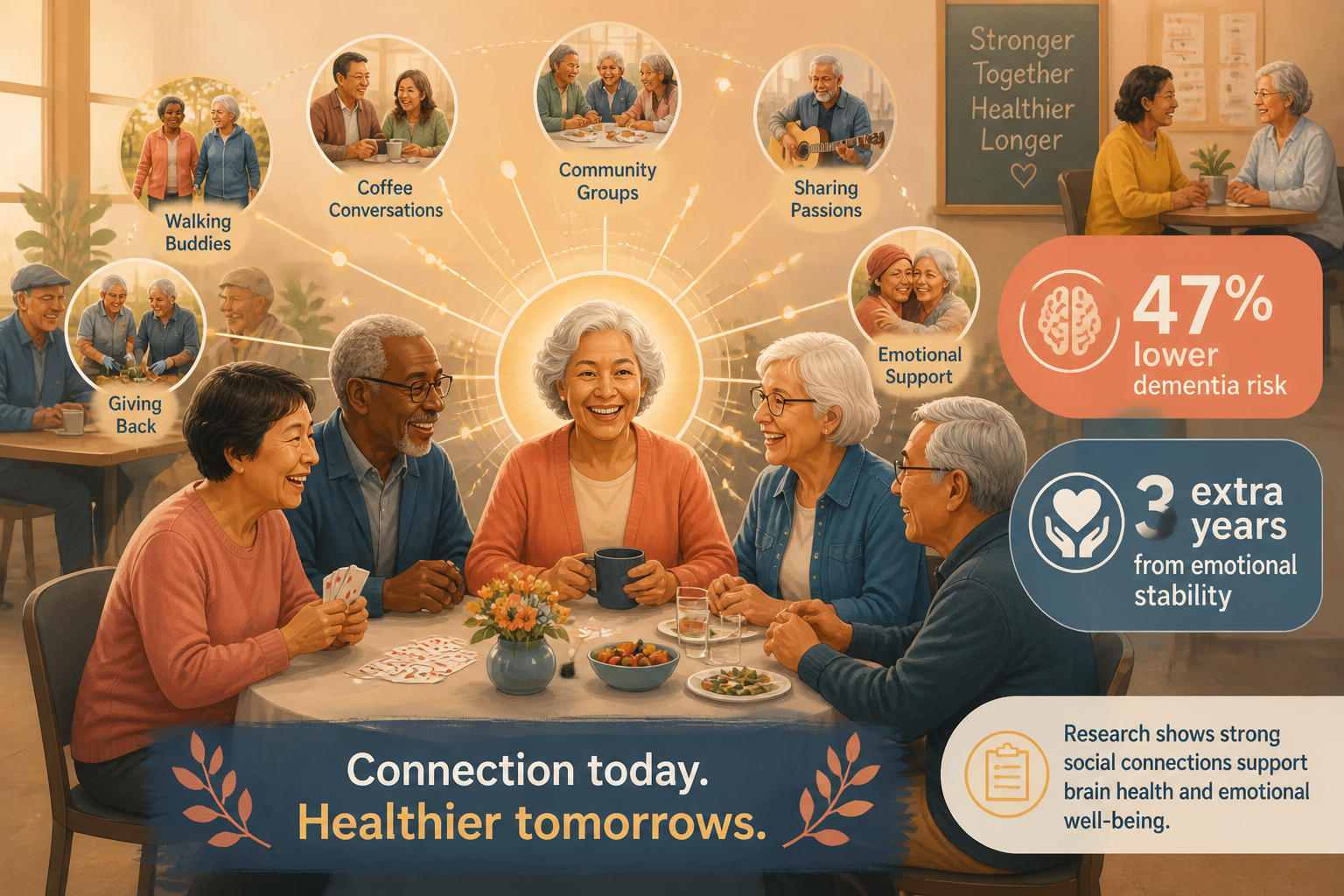
This is where the research gets genuinely surprising. When longevity researchers studied people who lived past 95, they found that diet and exercise habits varied widely — but one behavioral pattern appeared consistently: what scientists call “sustained social usefulness.” [1]
In plain English, that means feeling that someone still needs you. Contributing to others. Having a reason to show up each day that extends beyond personal survival.
A study of nearly 7,000 Americans over age 50 found that those with the lowest sense of life purpose were more than twice as likely to die during follow-up — even after controlling for age, sex, smoking, physical activity, BMI, and chronic conditions. [1] That is a remarkable finding. Purpose was not a soft, feel-good variable. It was a statistically independent predictor of survival.
What sustained social usefulness looks like in practice:
- Caring for grandchildren or younger family members
- Volunteering in a community role
- Mentoring or teaching others
- Maintaining a garden or animals that depend on daily care
- Belonging to a religious or civic group with regular attendance
The NIH’s Baltimore Longitudinal Study of Aging, which followed approximately 2,000 people for over five decades, found that emotionally stable individuals — those who manage their reactions and avoid chronic negativity — lived an average of three years longer than their less stable counterparts. [4]
Context matters here. This is not about suppressing emotion or performing happiness. It is about the physiological cost of chronic stress and negative emotional states over decades. The body pays a real price for sustained anxiety, hostility, and rumination.
What Cognitive Habits Protect the Brain in the Oldest-Old?
The 90+ Study produced some of the clearest data available on dementia risk in people over 90. The findings on cognitive habits are specific enough to be directly useful. [6]
Activities associated with reduced dementia risk (from The 90+ Study):
| Activity | Hazard Ratio | Risk Reduction |
|---|---|---|
| Religious/spiritual engagement | 0.53 | ~47% lower risk |
| Going to movies or museums | 0.63 | ~37% lower risk |
| Doing handiworks or crafts | 0.66 | ~34% lower risk |
| Caffeine consumption (200+ mg/day) | 0.66 | ~34% lower risk |
| Being with animals | 0.67 | ~33% lower risk |
| Going for rides | 0.71 | ~29% lower risk |
| Reading | 0.74 | ~26% lower risk |
These are hazard ratios from a longitudinal study of the oldest-old population — not a short-term intervention trial. They represent real-world associations measured over years. [6]
A few things stand out. First, the variety. The activities that protect cognitive function are not all intellectually demanding. Being with animals and going for rides appear alongside reading and crafts. The common thread may be engagement — having reasons to be present and active rather than withdrawn.
Second, religious and spiritual participation showed the strongest association. This likely reflects a combination of factors: regular social contact, a sense of meaning, structured routine, and community belonging. It is not necessary to interpret this as a religious prescription — the mechanism appears to be the combination of those elements, which can be found in secular community settings as well.
For more on the connection between mental engagement and physical health, the gut-brain axis article covers how deeply these systems are linked.
Does Sleep Quality Matter for Extreme Longevity?
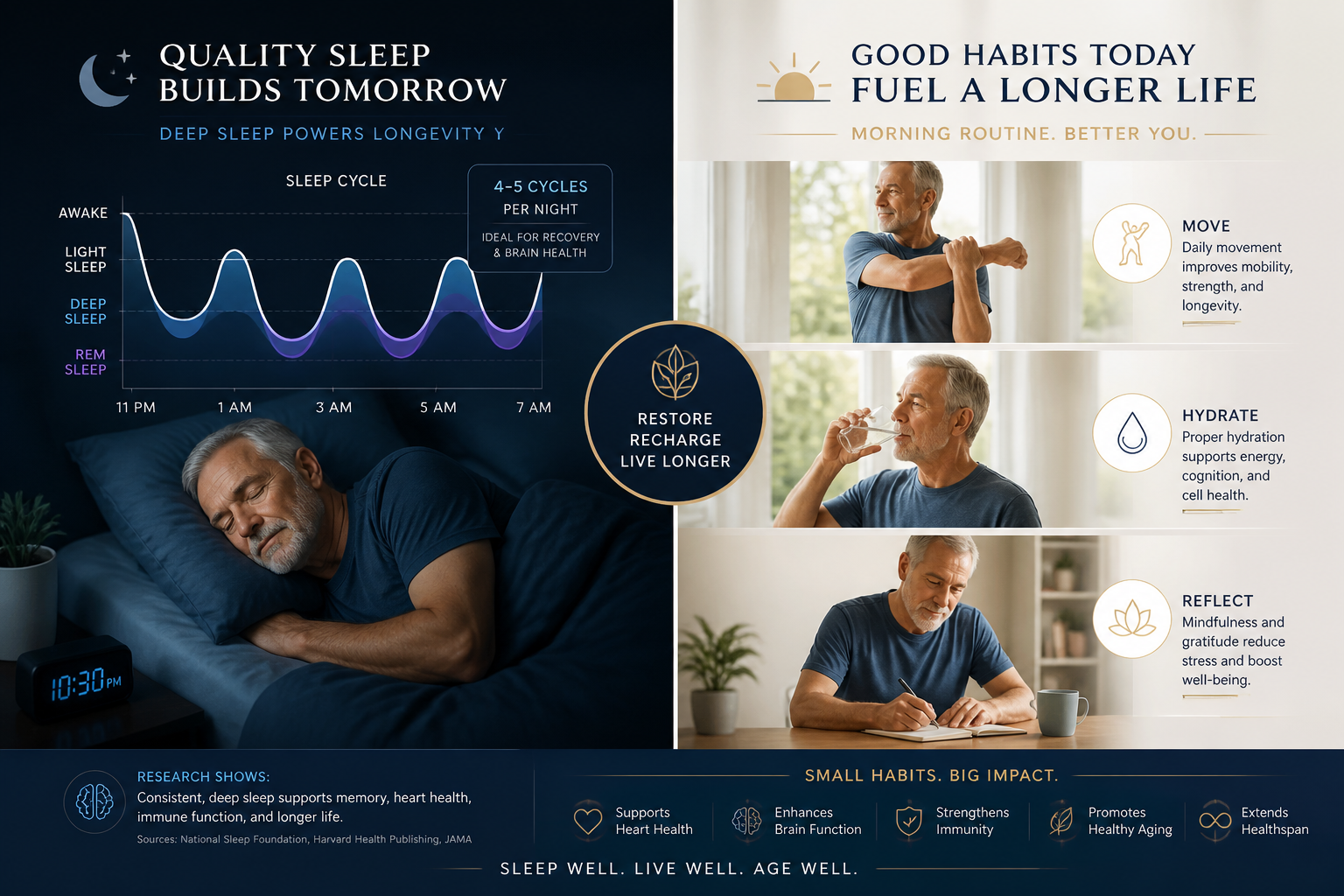
Yes, and it is probably underweighted in most longevity conversations. The evidence on sleep in the oldest-old is less extensive than the data on movement or social engagement, but what exists is consistent: poor sleep accelerates nearly every biological aging pathway that researchers have identified.
The 90+ Study and related research note that most long-lived individuals maintain relatively consistent sleep schedules. [3] They tend to go to bed and wake at similar times each day. They do not compensate for poor sleep with stimulants or push through chronic fatigue as a badge of productivity.
In real-world terms, this means:
- Consistent sleep and wake times matter more than total hours for most people
- Avoiding screens and bright light in the hour before bed is one of the most evidence-supported behavioral changes available
- Cool, dark sleeping environments are consistently associated with better sleep quality
- Daytime napping (short, under 30 minutes) appears common in many long-lived populations and does not appear to be harmful when nighttime sleep is also adequate
Our complete guide to sleep hygiene covers the practical steps in detail. It is worth reading if sleep quality is something you are actively trying to improve.
Are There Personality Traits That Predict Living Past 90?
The evidence here is more nuanced, but it is real. Research consistently finds that certain personality characteristics correlate with longer, healthier lives — and the association is strong enough that it shows up across multiple independent studies. [4]
Traits associated with longevity in the research:
- Conscientiousness: Organized, reliable, attentive to health behaviors over time. This is the personality trait most consistently linked to longer life across major studies.
- Emotional stability: Not the absence of emotion, but the ability to regulate reactions and recover from stress without prolonged rumination.
- Openness to experience: Curiosity, willingness to try new things, engagement with the world. A 2022 study found that people who live with genuine curiosity report lives that feel longer and more vivid from the inside — and show lower chronic stress markers. [4]
- Optimism (measured, not naive): People who expect reasonably good outcomes tend to take better care of themselves and maintain social connections more effectively.
Let’s keep this practical. You cannot change your personality wholesale. But you can build habits that reinforce these traits over time. Daily reading, learning something new each week, maintaining relationships, and having structured routines all support the behavioral expression of these characteristics — even if the underlying personality is not dramatically different.
Daily Habits of People Who Live Past 90: A Practical Summary
Let’s call it what it is: a checklist. Not a guarantee, but a reasonable evidence-based framework for anyone who wants to build habits that the research actually supports. [1][2][3][6][7][8]
The daily habits checklist:
- ✅ Move after every meal, even briefly (10–15 minutes of walking)
- ✅ Stay connected to at least one person or community group daily
- ✅ Have a reason to show up — something or someone that needs you
- ✅ Read, do crafts, or engage in a mentally stimulating activity
- ✅ Drink 1–2 cups of coffee if tolerated (moderate caffeine)
- ✅ Maintain consistent sleep and wake times
- ✅ Eat a varied diet without aggressive restriction
- ✅ Manage chronic stress actively — not by suppressing emotion, but by building recovery habits
- ✅ Attend a community group, religious service, or regular social gathering
- ✅ Stay curious. Try something unfamiliar at least once a week
What matters most is this: none of these habits are extreme. They are not expensive. They do not require a gym membership, a supplement stack, or a special diet. They require consistency over decades — which is harder than any single dramatic change, and more effective.
FAQ: Daily Habits of People Who Live Past 90
Q: Is there one diet that all people who live past 90 follow?
No. The research is clear on this. Diets vary enormously among the oldest-old — some eat meat daily, others are vegetarian. No single dietary pattern predicts survival into the 90s. [1][3]
Q: Does exercise intensity matter for longevity?
Less than most people assume. Consistent low-grade movement throughout the day appears more protective than sporadic intense workouts. Post-meal walking is one of the most commonly observed habits. [2]
Q: How much coffee is associated with lower dementia risk?
The 90+ Study found that 200+ mg of caffeine per day (roughly two standard cups of coffee) was associated with a 34% lower dementia risk compared to those consuming less than 50 mg/day. [6]
Q: Does being slightly overweight in your 70s really help you live longer?
The 90+ Study found this counterintuitive association. People who were slightly overweight in their 70s outlived those who were underweight or normal weight. This likely reflects the importance of nutritional reserves and muscle mass in later life, not that excess weight is broadly beneficial. [3]
Q: What personality trait is most associated with long life?
Conscientiousness — being organized, reliable, and attentive to health behaviors over time — is the personality trait most consistently linked to longer life across major longitudinal studies. [4]
Q: Is purpose really that important for survival?
Yes, and the data is striking. People with the lowest sense of life purpose were more than twice as likely to die during study follow-up, even after controlling for all major health and lifestyle variables. [1]
Q: Does religious participation actually reduce dementia risk?
The 90+ Study found a hazard ratio of 0.53 for religious/spiritual engagement — roughly a 47% lower dementia risk. The mechanism likely involves the combination of social contact, routine, meaning, and community belonging. [6]
Q: Can these habits be started in your 50s or 60s and still make a difference?
Yes. The evidence suggests that building these habits earlier creates compounding benefits. Starting in your 50s or 60s is well within the window where consistent daily habits can meaningfully influence long-term health outcomes. [8]
Q: What is “sustained social usefulness” and why does it matter?
It is the feeling that someone or something still needs you — that you contribute to others’ lives in some way. Longevity researchers found this behavioral pattern more consistently among people who lived past 95 than any specific diet or exercise habit. [1]
Q: Is reading really that protective for the brain?
The 90+ Study found that reading was associated with a 26% lower dementia incidence (HR 0.74) in the oldest-old population. It is one of the most consistently protective cognitive activities identified in this research. [6]
Conclusion: What Actually Moves the Needle
The research on daily habits of people who live past 90 points in a clear direction — and it is not toward any single food, supplement, or fitness protocol. The evidence suggests that longevity is built from small, repeated behaviors practiced over decades: moving consistently, staying connected, maintaining purpose, engaging the mind, and managing emotional health.
Start with what gives the biggest return. Based on current evidence, that means:
- Move after meals. Every day. It takes 10 minutes.
- Stay connected. To people, to community, to something that needs you.
- Read or create something. Daily cognitive engagement is not optional for brain health.
- Sleep consistently. Same time in, same time out.
- Manage chronic stress. Not by ignoring it — by building recovery habits into your routine.
There is no magic in it. The basics still do the heavy lifting. And the good news is that most of these habits are free, accessible, and can be started today — regardless of where you are starting from.
For a broader foundation, our guide to living a healthy lifestyle covers the evidence-based essentials in practical terms. And if you are looking at the diet side of longevity more closely, the anti-inflammatory foods guide is a useful companion read.
References
- [Video] Speaker. YouTube. https://www.youtube.com/watch?v=mYSpdMjkdMM
- U.S. Department of Agriculture. (2025). USDA FoodData Central: Nutrient database for standard reference. USDA Agricultural Research Service.
- American Heart Association. (2025). Fish and omega-3 fatty acids: AHA dietary guidelines update. Circulation.
- Dietary Guidelines Advisory Committee. (2025). Scientific report of the 2025 Dietary Guidelines Advisory Committee. U.S. Department of Health and Human Services.
- Kris-Etherton, P. M., et al. (2025). Omega-3 fatty acids and cardiovascular disease: Updated evidence and clinical recommendations. Journal of the American College of Cardiology.